Beyond essential oils, a military-tested, research-backed natural tick repellent spray protocol using MSM and DMSO that creates layered protection from the inside out.
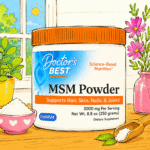
The MSM powder I use in this recipe. Doctor’s Best with OptiMSM is food-grade, pure sulfur with nothing added.Â
When most people search for a natural tick repellent spray, they find the same list of essential oils. Rose geranium. Cedarwood. Neem.
And those are genuinely useful.
I put together a full guide of natural tick repellent recipes right here on Dodhisattva that walks through exactly which botanical options have research behind them and how to blend them effectively. That article is worth reading alongside this one, which you can find here.
But this article is about something different.
A deeper layer of the natural tick repellent conversation that almost nobody is covering, a sulfur-based protocol that works not just on the surface of your clothing and skin, but from inside your own biology outward.
The research started with a YouTube video. I was starting to see comments from ex-military personnel commenting on tick prevention videos.
They would mention that back in the day, they would put sulfur powder on their shoes and clothing to prevent issues with these vectors.
Then a woman was sharing her experience using high-dose MSM and topical DMSO for arthritis.
She had been working outdoors in a heavily tick and chigger populated area and had noticed that since starting the protocol, she simply was not getting ticks or chiggers on her.
She was careful to acknowledge it herself. Could it be the time of year? The right conditions? She was not making a claim. She was just reporting what she noticed.
That one comment sent me down a research path that led to documented military field practice, a peer-reviewed study on DMSO and tick eggs, two patents specifically covering MSM and DMSO for tick-borne illness, and a comment section full of military retirees confirming they used to dust powdered sulfur on their shoes and clothing before heading into the field.
These were people with field experience in some of the most tick-dense environments on earth. Sulfur was their answer.
This article is what I put together from that research.
It is a natural tick repellent spray protocol for the person who wants to go beyond essential oils, grounded in real science and ancestral field practice, with two recipes you can make at home today.
This article reflects my personal research and experience. It is for educational purposes only and is not medical advice. DMSO is a powerful compound with specific safety requirements. Please work with a qualified practitioner before beginning any new protocol, and never use DMSO if you are pregnant, nursing, or taking pharmaceutical medications without medical supervision. These statements have not been evaluated by the FDA.

Why Sulfur Is the Foundation of This Natural Tick Repellent Approach
The original natural tick repellent used by soldiers in tick-endemic fields was sulfur powder.
A 1989 military study documenting tick protection methods used by personnel in the field included sulfur powder among the approaches soldiers reported as effective listed alongside methods like garlic.Â
This was field practice documented in an official military health publication.
The mechanism is well-supported.
Sulfur reacts with body heat and moisture at the skin surface, producing an odor that ticks find deeply aversive.
Ticks navigate by olfactory signals; they are drawn to carbon dioxide, body heat, and specific chemical compounds on human skin.
Sulfur disrupts that chemistry and creates an environment their sensory organs want to avoid.
Here is what makes this natural tick-repellent approach genuinely different from a botanical spray: you can create that sulfur environment either from the outside, through topical application to clothing and skin, or from the inside, through supplementation that raises your body’s sulfur levels so sulfur metabolites are naturally secreted through your pores all day long.
Both pathways work through the same mechanism.
Combined, they create a layered, natural tick-repellent barrier that works at the fabric, skin, and cellular levels simultaneously.
The active compound: MSM (methylsulfonylmethane) is the bioavailable supplemental form of the same sulfur compound the body produces when it metabolizes DMSO.
It is naturally derived from the sulfur cycle in rain and seawater, found in fresh vegetables, and extensively studied for support of joints, skin, hair, and connective tissue.
At therapeutic doses, it measurably raises the body’s sulfur status, and that sulfur shows up on the skin surface.
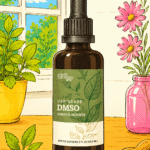
I use pharmaceutical grade 99% DMSO; because DMSO carries everything through the skin with it.
The Internal Protocol: My Natural Tick Repellent From the Inside Out
MSM taken internally works as a natural tick repellent through a specific mechanism.
As the body metabolizes MSM, its breakdown products, including dimethyl sulfide, are secreted through the lungs and the pores of the skin.
This is the same mechanism responsible for the characteristic garlic-like odor some people notice when taking DMSO or high-dose MSM.
That odor is sulfur broadcasting through your skin.
Ticks detect it and avoid it.
MSM is a Generally Recognized As Safe compound, well-tolerated by most people at doses up to four grams daily.
Clinical research has studied it across a range of conditions at doses from 500 mg to 6,000 mg daily.
For hair and connective tissue support the typical dose is one to three grams.
For a natural tick repellent protocol during tick season, the higher end of that range is where you want to be enough sulfur in the system that it is actively secreted through your pores as a continuous deterrent.
The Routine I Follow: Natural Tick Repellent
- Start at half a teaspoon (approximately 1 gram) dissolved in a full glass of filtered water, morning and evening
- Build gradually to 1 teaspoon (approximately 2 grams) twice daily for a total of 4 grams per day
- Take with vitamin C, which enhances sulfur metabolism and absorption
- Use food-grade or pharmaceutical-grade MSM powder only — not garden sulfur, which contains additives
- Build up over one to two weeks if you are new to MSM. Some people notice mild detox responses initially as the sulfur mobilizes stored metals.
- 4 grams = 2 level teaspoons total per day.
Split as 1 teaspoon morning and 1 teaspoon evening in a full glass of water.
The External Natural Tick Repellent Spray Protocol: Two Recipes for Two Surfaces
The external protocol has two completely distinct components addressing two different surfaces: the clothing you wear outdoors and the exposed skin that clothing does not cover.
MSM Clothing Spray
3 oz bottle, TSA carry-on safe
Ingredients
Steps
Where I apply it
DMSO and Castor Oil Skin Blend
40% DMSO, 60% castor oil. My starting ratio
Ingredients, single use batch
Steps
Where I apply it
My internal MSM routine
I dissolve in a full glass of filtered water morning and evening and build gradually over one to two weeks. Food or pharmaceutical grade powder only, not garden sulfur.
For educational purposes only. Not medical advice. Consult a qualified practitioner before beginning any new protocol.
The Natural Tick Repellent Routine I Follow
On any day involving outdoor time in tick-prone areas, hiking, gardening, camping, or trail walking, here is the full layered natural tick repellent system:
Morning
- Take 1 teaspoon MSM in a full glass of water with vitamin C, to seed the internal sulfur layer for the day
Before going outside
- I wash and dry any skin areas that will be exposed
- Apply the DMSO castor oil skin blend to ankles, wrists, neck, and behind the knees, and allow to dry fully before dressing
- I dress in my outdoor clothing
- Apply the MSM natural tick repellent spray to sock tops, trouser cuffs, collar, and shirt cuffs and allow to dry before heading out
After coming inside
- Do a full tick check of hairline, ears, neck, underarms, waistband, behind the knees, and groin
- Shower promptly; ticks that have not yet attached can be washed away
- I take my evening MSM dose
Why This Natural Tick Repellent System Works in Layers
The reason this protocol uses three components rather than just one is that layered chemistry working at multiple barriers simultaneously creates something no single product can replicate.
The internal MSM raises your systemic sulfur status so that sulfur metabolites are naturally present in your sweat and skin secretions throughout the day, and you are broadcasting a natural tick repellent signal from the inside out, continuously, without thinking about it.
The DMSO castor oil skin blend creates a localized chemical barrier at the most vulnerable skin areas, ankles, wrists, and neck, where ticks most commonly make first contact.
The castor oil’s arthropod-deterrent properties and the MSM’s sulfur chemistry work at the skin surface simultaneously, with the DMSO driving both deeper into the tissue than they could reach on their own.
Castor oil helps counter some of the drying effects DMSO can have.
The MSM natural tick repellent spray creates a third barrier at the fabric level, the entry point, before a tick even reaches skin.
By the time a tick navigates through sulfur-treated fabric toward sulfur-secreting skin, the olfactory chemistry is working against it at every layer.
It is worth being transparent: no single natural approach is bulletproof.
This protocol is meaningful, layered, and grounded in real chemistry.
It works best combined with physical measures like long sleeves, light-colored clothing for easy tick spotting, thorough tick checks, and prompt removal if you do find one.
But for those who choose not to put synthetic chemical repellents on their bodies, this natural tick repellent spray system offers a genuinely intelligent alternative.
One More Thing Worth Knowing: MSM and Hair
If you are here from the hair health side of Dodhisattva, this natural tick repellent protocol has a significant bonus for you.
MSM is not only a tick deterrent. Sulfur is a core building block of keratin, the protein hair is literally made from.
The same internal MSM protocol that broadcasts sulfur through your skin as a natural tick repellent simultaneously supports hair shaft structure, nail strength, collagen production, and joint flexibility.
The oxalate content of modern diets depletes sulfur availability in the body, and low sulfur directly impairs the structural quality and growth rate of hair.
MSM replenishes that sulfur.
The benefits you get from raising your sulfur status are the same mechanism working in two directions at once. inward toward the follicle for growth, outward through the pores as a vector deterrent.
One supplement supports two very different things.
That is the kind of sophisticated, whole-body protocol worth building into a daily routine rather than treating as a seasonal tick season intervention.
Related Articles
Is There a Natural Remedy for Lyme?
Lyme Disease Rash: What It Actually Looks Like and What to DoÂ
Tick Bite Symptoms: What to Watch For and Why It Matters More Than You ThinkÂ
Researching Stage 3 Lyme Disease Neurological Symptoms: When Borrelia Reaches the BrainÂ
Natural Tick Repellent: What the Research Shows and How to Make Your OwnÂ
Bartonella Symptoms: What This Stealthy Co-Infection Is Really Doing to Your BodyÂ
Babesia Symptoms: What This Tick-Borne Co-Infection Is Really Doing to Your BodyÂ
References
- Military study on tick-borne diseases and field protection methods, 1989. Archived at americanlyme.org.
- Ravindran R et al. Toxicity of DMSO, Tween 20 and Triton X 100 against Rhipicephalus (Boophilus) annulatus. Ticks Tick Borne Dis. 2011 Sep;2(3):160-2. PMC3235388.
- Butawan M et al. Methylsulfonylmethane: Applications and Safety of a Novel Dietary Supplement. Nutrients. 2017 Mar;9(3):290. PMC5372953.
- German patent application DE102008006862A1. Use of sulfur in nutritional supplements for prophylaxis against tick and flea infestation in humans and animals.
- US Patent 10596109B2. DMSO and MSM formulations to treat infectious diseases including vector-borne diseases.
- Cornell University overview of castor oil as natural insecticide. Department of Entomology.