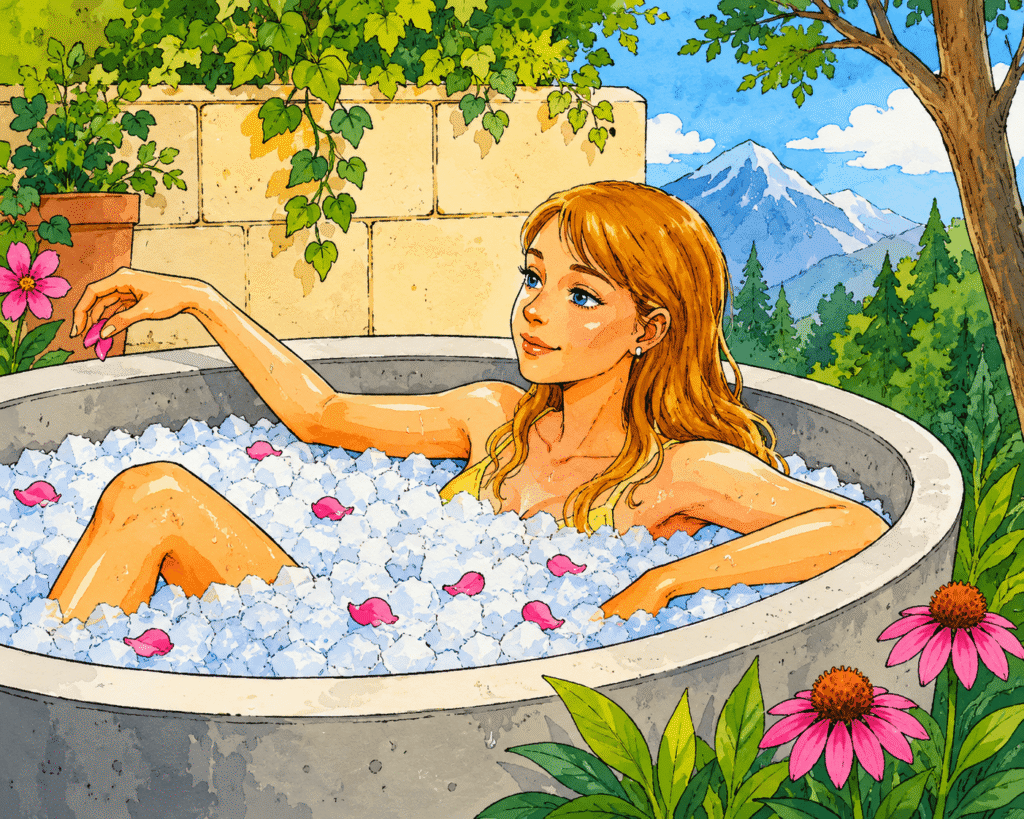
The first time I took an ice bath I was sitting in geothermal spring water with 14 pounds of ice added in.
Fifteen minutes.
I came out feeling supercharged in a way I had not felt in years.
That experience sent me down a rabbit hole that eventually led me to the ancient Kundalini yoga teachings on cold water hydrotherapy, a practice called Ishnaan, which describes what happens in the body during cold water immersion with a precision that modern science is only now beginning to verify.
What I found changed how I think about the glands, the nervous system, and the body’s own pharmacy.
What Happens in Your Body During Cold Exposure
When you enter cold water your body responds immediately and intelligently.
The capillaries near the skin surface constrict rapidly, pushing blood toward the core organs to protect them.
The heart rate changes, the breath shifts, and the nervous system moves from its default state into a heightened state of alertness and presence.
When you exit the cold, blood rushes back to the surface, delivering freshly oxygenated blood to the tissues, muscles, and organs that were just protected.
This vascular pumping action, the constriction and dilation cycle, is one of the most powerful forms of internal circulation support available without medication or intervention.
What research shows cold therapy supports:
Â
Reduction in systemic inflammation by lowering inflammatory cytokine levels.
Improved lymphatic circulation since the lymphatic system has no pump of its own and relies on muscle movement and vascular changes to move lymph fluid.
Activation of brown adipose tissue which generates heat by burning calories and is associated with improved metabolic function.
Increased norepinephrine production, sometimes by as much as 300%, which improves mood, focus, and pain tolerance.
Improved vagal tone, meaning the vagus nerve becomes more responsive and the nervous system becomes more resilient to stress over time.
Faster muscle recovery after physical exertion by reducing metabolic waste buildup in the tissues.
The Vagus Nerve Connection
The vagus nerve, which runs from the brainstem through the neck, chest, and abdomen, is directly stimulated by cold water exposure especially when it hits the face and the back of the neck.
This is one reason cold therapy has such a profound effect on mood, anxiety, and the sense of calm and clarity that follows a cold plunge or cold shower.
Regular cold exposure essentially trains the vagus nerve to have a higher threshold before triggering the stress response.
Over time this translates to greater emotional resilience, better heart rate variability, and a nervous system that recovers from stress more quickly.
What Kundalini Yoga Teaches About Cold Water
The Kundalini yoga tradition has a practice called Ishnaan, cold water hydrotherapy, that Yogi Bhajan taught as one of the most important daily practices for maintaining health, vitality, and glandular strength.
The teachings go far deeper than the Western cold therapy conversation.
The glandular system is the key.
In Kundalini teachings the glands are considered the guardians of health.
The pituitary gland, the pineal gland, the thyroid, the adrenals, and the sexual glands make up a system that governs mood, immunity, hormonal balance, and consciousness itself.
Ishnaan is described as a way to strengthen and activate this entire glandular system simultaneously.
When cold water contacts the skin, particularly certain nerve meridian points along the body, it sends a signal through the nervous system that activates the glands to secrete in a balanced and coordinated way.
The capillary system is the medicine.
Yogi Bhajan taught that the capillaries open and close during cold water exposure, and that this opening and closing is what keeps the blood from depositing toxins in the tissues.
When the capillaries are sluggish and do not open and close properly, waste accumulates, circulation becomes stagnant, and the body begins to age more rapidly.
Ishnaan is said to keep the capillaries young.
The electromagnetic field of the body.
The Kundalini teachings also describe cold water as a way to strengthen the electromagnetic field, what is called the aura or pranic body, which is the energetic boundary that determines how much external influence affects you.
A strong pranic body means you are less susceptible to environmental stress, emotional contagion from others, and energetic depletion.
Whether you hold this as metaphor or literal reality, the feeling after a cold plunge of being more present, more boundaried, and more energetically clear is something most people describe without prompting.
The Ishnaan Protocol
Kundalini yoga prescribes a specific way to do cold water hydrotherapy for maximum glandular benefit.
The body is massaged with almond oil or another nourishing oil before entering the cold water.
The water should be cold, not freezing, comfortable enough to stay in for several minutes.
Certain parts of the body are kept out of the cold, specifically the areas over the kidneys and for women, the breasts and the area between the navel and thighs during the practice.
The practice is ideally done in the early morning before the sun rises, which Kundalini tradition calls the Amrit Vela, the ambrosial hours, when the glandular system is most receptive.
You massage the skin vigorously while in the cold water to keep the capillaries moving and the blood circulating.
Cold shower
Daily practice
Ice bath
Deep immersion
- 1Start your shower at your normal warm temperature and wash fully for 3 to 5 minutes.
- 2Turn the water to cold. Beginners start at 30 seconds and build toward 2 to 3 minutes over several weeks.
- 3Focus on slow controlled breathing rather than gasping. The breath transforms shock into practice.
- 4Let cold water contact the back of your neck and face to maximize vagal nerve stimulation.
- 5Towel dry vigorously with a rough towel to further stimulate circulation and lymphatic flow.
- 6Notice your energy, mood, and mental clarity in the hour that follows.
Cold exposure timer
00:30
Kundalini tip: For maximum glandular benefit, practice first thing in the morning during the ambrosial hours before sunrise. Massage the skin with almond oil before entering the water.
- 1Optional: massage the body with almond oil before entering the water following the Ishnaan protocol.
- 2Fill a bathtub with cold water and add ice until the temperature reaches 50 to 59 degrees Fahrenheit.
- 3Enter slowly. Begin with 5 minutes and build toward 10 to 15 minutes over several sessions.
- 4Keep the face and back of the neck in contact with cold air or water to activate the vagus nerve.
- 5Massage the skin gently while immersed to keep the capillaries moving and blood circulating.
- 6Exit and allow the body to rewarm naturally. This rewarming phase is where key metabolic benefits occur.
Immersion timer
05:00
Aim for 3 to 4 sessions per week. Avoid ice baths within 4 hours of intense exercise if muscle building is a goal as it can blunt some adaptation signals.

Who Should Approach Cold Therapy With Caution
People with cardiovascular conditions, Raynaud’s disease, or cold urticaria should consult a practitioner before beginning cold immersion.
Those with adrenal fatigue or very low cortisol should start gently with brief cool showers rather than full cold plunges as the cold shock response requires adrenal output.
Pregnant women should avoid ice baths.
A Practice Worth Returning To
Cold water therapy is not new.
Every traditional culture from Scandinavian sauna culture to Japanese Misogi purification to the Kundalini Ishnaan practice has understood intuitively that cold water does something to the body and spirit that warm water cannot.
Modern research is filling in the mechanisms but the experience has always been the same.
You go in ordinary.
You come out changed.
The content shared on Dodhisattva is for informational and educational purposes only and is not intended to diagnose, treat, cure, or prevent any condition. Please consult a qualified practitioner before beginning any new health protocol.