
Mewing how to is one of the most searched topics in the natural facial health space right now, and for good reason.
Most people who find it get the basic idea but miss the single most important detail that determines whether mewing actually works.
It is not about where the tip of your tongue goes.
It is about the back third.
This guide covers everything you need to know to mew correctly from day one, the mistakes that make the practice ineffective, what results are actually realistic and when, and how mewing connects to your posture, your breathing, your lymphatic system, and your nutrition.
If you have been dabbling in mewing and wondering why nothing seems to be changing, this article will explain why.
What Is Mewing and Who Is Mike Mew
Mewing is the practice of maintaining correct tongue posture at rest, with the entire tongue pressing up against the roof of the mouth, lips sealed, and breathing through the nose.
The term comes from Dr. Mike Mew, a British orthodontist and the son of Dr. John Mew, who founded the field of orthotropics in the 1960s.
Orthotropics is built on a single radical argument: facial structure is not primarily determined by genetics.
It is shaped by the mechanical forces acting on the developing face over time.
The forces of tongue posture, chewing, and nasal breathing either build a wide, forward-grown facial structure with defined cheekbones and a clear airway, or they allow the face to grow downward and backward, producing narrow arches, crowded teeth, a recessed chin, and a compressed airway.
Dr. John Mew spent decades documenting this in clinical practice.
His son Mike took the argument public through YouTube and social media, where it went viral among people who had been told their crowded teeth and recessed jaws were simply genetic, and nothing could be done.
The medical and orthodontic establishment has pushed back hard, going so far as to strip Mike Mew of his orthodontic license in the UK.
The irony is that the evidence supports the Mews.
Weston A. Price documented the same phenomenon across indigenous cultures worldwide in the 1930s, decades before orthotropics existed as a field.
Every culture that ate traditional ancestral diets has wide arches, straight teeth, clear airways, and a defined facial structure.
Within a single generation of adopting processed food, arch width collapsed, teeth crowded, and facial structure changed dramatically.
That is not genetics.
That is the environment.
That is force.
How to Mew Correctly: Step by Step
The most common reason mewing does not work is incorrect tongue placement.
Most people put the tip of their tongue on the roof of their mouth and consider the job done.
This is not mewing.
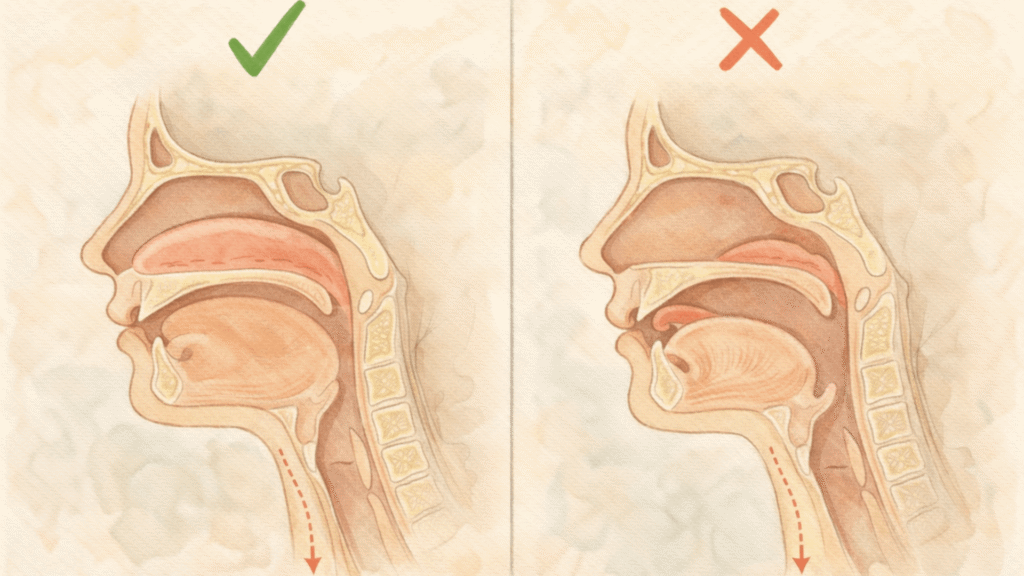
This is the front third of the tongue touching the palate, while the back two-thirds hang down into the throat, doing nothing.
Correct mewing requires the entire tongue to press up against the palate from the back of the front teeth all the way to the soft palate at the back of the mouth.
Here is how to find the position.
Start by swallowing.
Notice how your tongue naturally rises and presses against the full roof of your mouth during the swallow.
That full palate contact is exactly what you are looking for.
Now try to hold that position without completing the swallow.
That is the mewing position.
The palatal rugae are the small ridges just behind your upper front teeth.
The tip of your tongue should rest just behind them, not on them or pushing against your teeth.
From there, the tongue should spread back along the entire palate.
The sides of the tongue should press outward against the upper molars.
The back of the tongue should press up against the soft palate.
This is the full suction hold.
Your lips should be sealed gently together.
Your teeth should be lightly touching or very slightly apart, never clenched.
You should be breathing through your nose exclusively.
If you are breathing through your mouth you are not mewing, regardless of where your tongue is.
It will feel uncomfortable at first.
Your tongue muscles are likely weak from years of resting on the floor of the mouth.
The position will feel strained for the first few weeks.
This is normal and it improves as the muscles strengthen.
The Most Common Mewing Mistakes
Only using the front third of the tongue is the single most common error and the one that makes the entire practice ineffective.
The front third of the tongue pressing on the palate creates almost no useful force.
It is the back third, pressing up and forward against the soft palate and the posterior maxilla, that generates the mechanical stimulus for bone remodeling.
Without the back third engagement, you are essentially doing nothing.
Pushing the tongue upward with active muscular force rather than creating a gentle suction hold is the second most common mistake.
Mewing is not about pushing.
It is about creating a passive suction seal the way your tongue naturally does during a swallow.
Active pushing can create jaw tension and headaches and is not sustainable throughout the day.
Clenching the teeth is another common error, particularly in people who already have jaw tension.
The teeth should be lightly touching at most.
Clenching creates unnecessary muscular tension and works against the relaxed, sustained pressure that mewing is designed to create.
Forgetting to mew throughout the day is perhaps the most practical challenge.
Mewing only works through sustained, consistent pressure over time.
Doing it for ten minutes and forgetting about it the rest of the day will produce no results.
The goal is for correct tongue posture to become your automatic resting state the same way it is in people who grew up nasal breathing and eating ancestral diets.
Setting reminders on your phone for the first few months helps build the habit until it becomes automatic.
Giving up too soon is the final common mistake.
Bone remodeling is a slow biological process.
Anyone who tells you they got dramatic results in two weeks is either very young, exaggerating, or confusing the changes in muscle tone and facial definition that happen relatively quickly with structural bone changes that take much longer.
What Mewing Actually Does to Your Face
The mechanism behind mewing is straightforward once you understand how bone responds to mechanical force.
Bone is not static.
It is constantly being remodeled through the action of osteoblasts, which build new bone, and osteoclasts, which break down old bone.
The direction and intensity of mechanical forces acting on bone influence where osteoblasts deposit new material.
This is Wolff’s Law, and it is not controversial.
It is basic bone physiology.
The tongue pressing upward and forward against the palate with sustained gentle pressure provides a constant mechanical stimulus to the maxilla and the surrounding facial bones.
Over time this stimulus encourages lateral expansion of the palate, forward growth of the midface, and upward definition of the cheekbones.
It also lifts the hyoid bone, decompressing the cervical lymph nodes and opening the airway.
The key phrase is over time.
In children and adolescents whose facial sutures have not yet fully fused, results can be significant and relatively rapid, occurring over months to a few years.
In adults whose sutures have largely closed, results are slower and more subtle, but they are not zero.
Adult bone still responds to sustained mechanical force.
The process is slower and requires more consistency, but measurable changes in facial definition, muscle tone, and airway space are reported by adults who mew consistently over one to three years.
Mewing Results: What to Expect and When
Honest expectations are essential here because the internet is full of dramatic before and after photographs that are often misleading, lighting dependent, or represent results from very young people during peak developmental windows.
For children under twelve, consistent mewing combined with nasal breathing and ancestral nutrition can produce significant changes in arch width, facial definition, and airway space within one to three years.
This is the developmental window when bone is most responsive and the sutures of the facial skeleton are still highly malleable.
If you have children, getting them to nasal breathe and develop correct tongue posture is one of the most valuable things you can do for their long term health.
For teenagers, results are still significant but slower than in young children.
The developmental window is partially open, and bone is still highly responsive to force.
Teenagers who mew consistently can expect meaningful changes over one to three years.
For adults the honest answer is that structural bone changes are possible but slow.
What happens relatively quickly, within weeks to a few months, is a change in muscle tone and facial definition.
The masseter muscles strengthen.
The face looks more defined.
The jawline becomes more visible.
These changes come from the muscular work of maintaining tongue posture, not from bone remodeling, and they are real and noticeable.
Structural bone changes take longer, typically one to three years of very consistent practice, and are more subtle in adults than in children.
Photograph yourself from the same angle in the same lighting every three months rather than every week.
The changes are too gradual to see week to week and daily comparison leads to discouragement.
Three month intervals give you a meaningful comparison that reflects actual progress.

Mewing and Forward Head Posture
This is the connection that most mewing guides completely miss and it is one of the main reasons people mew for months with no results.
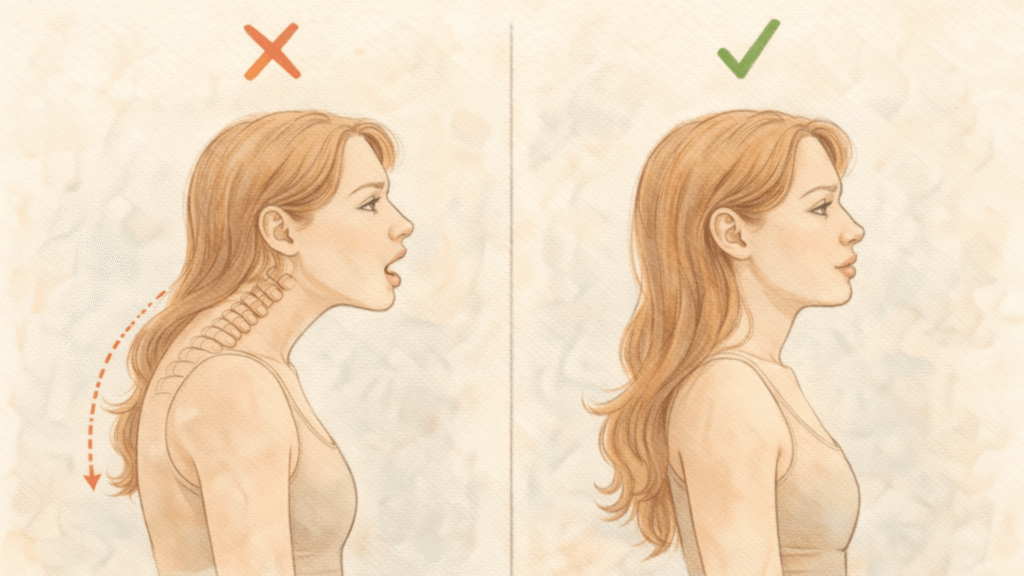
You cannot mew effectively with forward head posture.
When the head moves forward in front of the shoulders, the hyoid bone drops.
When the hyoid drops, the tongue is pulled downward and backward.
The entire musculature that supports the tongue in its elevated position against the palate becomes mechanically disadvantaged.
You can try to force the tongue up against the palate, but the tension in the neck and throat muscles will work against you constantly.
Correcting forward head posture is a prerequisite for effective mewing, not an optional add on.
Chin tucks, where you gently retract the chin straight back to create a double chin, are the single most important exercise for restoring cervical alignment.
Ten repetitions several times a day done consistently over weeks and months will make a significant difference.
Wall angels, where you stand with your back against the wall and slide your arms up and down while maintaining contact, train the scapular muscles that hold the shoulders back and allow the head to sit properly over the spine.
Thoracic extension over a foam roller addresses the mid back rounding that drives the head forward.
If you are working through the tongue posture article we published earlier in this series, the wall alignment and posture correction material there covers these exercises in detail.
Read that first if you have not already.
Mewing and Nasal Breathing
Mewing and mouth breathing are mutually exclusive.
If your mouth is open, your tongue cannot maintain the suction hold against the palate.
The two positions are anatomically incompatible.
This means that anyone who is a habitual mouth breather will find mewing nearly impossible to sustain throughout the day until they address the mouth breathing directly.
Nasal breathing and mewing reinforce each other.
When the tongue is correctly positioned on the palate with the lips sealed, nasal breathing becomes the natural and automatic result.
When you breathe through the nose consistently, the tongue naturally wants to rest higher because the position feels more stable and supported.
Nasal breathing also produces nitric oxide in the paranasal sinuses, a molecule with powerful vasodilatory, antimicrobial, and anti-inflammatory effects.
Mouth breathing bypasses this entirely.
The filtering, humidifying, and warming of air that the nasal passages provide is also completely bypassed by mouth breathing, sending cold, unfiltered, dry air directly into the lungs and airways.
The downstream effects on systemic health are significant and we cover them in full in the mouth taping post coming later in this series.
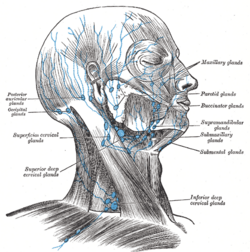
Illustration from Gray’s Anatomy. Henry Gray and Henry Vandyke Carter. Public domain.
Mewing How To and Lymphatic Drainage
Correct tongue posture does something that almost no mewing guide discusses, and it is one of the most clinically significant benefits of the practice.
It lifts the hyoid bone.
The hyoid is a small U shaped bone at the base of the tongue that sits at the top of the cervical lymphatic pathway.
When the tongue is correctly elevated against the palate, the hyoid is lifted and held in a higher position.
This decompresses the cervical lymph nodes that cluster around it and opens the drainage pathway that carries lymph from the entire face and head down toward the clavicle.
In people with chronic low tongue posture, this pathway is chronically compressed.
Facial puffiness, under-eye congestion, sinus congestion, and general facial stagnation are often partly due to this compression.
Restoring correct tongue posture through consistent mewing practice is one of the most upstream interventions available for facial lymphatic health because it addresses the structural compression rather than just manually moving fluid.
If you are doing regular facial lymphatic drainage work alongside mewing, the results compound significantly.
The manual drainage work moves existing congestion.
The mewing practice changes the structural position that was creating the congestion in the first place.
For a full guide to the facial lymphatic drainage protocol that works best alongside mewing, read our facial lymphatic drainage article.

Mewing and Nutrition
Mewing works better when the body has the raw materials for bone remodeling.
Mechanical force without nutritional support is like trying to build a house without materials.
The force signals are there but the body cannot act on them effectively.
The nutritional foundation for bone remodeling is not calcium.
Calcium supplementation without the cofactors that direct it into bone is largely ineffective and potentially counterproductive.
The cofactors that matter are vitamin K2, which directs calcium into bone and away from soft tissue, retinol in its true form from liver and cod liver oil rather than beta carotene, vitamin D3 which must be paired with K2 for proper calcium metabolism, magnesium which activates hundreds of enzymatic processes involved in bone metabolism, copper which is essential for collagen cross linking and bone matrix formation, and collagen itself from bone broth and connective tissue rich foods.
Weston A. Price identified fat soluble vitamins, which he called Activator X and which we now understand to be primarily K2, as the central nutritional factor separating cultures with exceptional facial structure from those without.
His Activator X was found in the butterfat of grass fed cattle, the organs of pasture raised animals, and certain fermented foods.
These are the foods that support the bone remodeling that mewing is trying to stimulate.
We cover the full ancestral nutrition protocol for facial structure in detail in the upcoming nutrition post in this series.
The Complete Daily Mewing How To Practice
Morning: Before getting out of bed, set your tongue position consciously.
Lips sealed.
Back third of the tongue pressing up and back.
Nasal breathing only.
Set this as your intention before your feet hit the floor.
Throughout the day: Every time you think of it, check your tongue position, your lip seal, and whether you are breathing through your nose.
Phone reminders every two hours for the first three months help build the habit.
Pay particular attention to tongue position while walking, exercising, and working at a screen.
Posture: Practice chin tucks at red lights, at your desk, and whenever you notice your head drifting forward.
Do wall angels morning and evening.
The posture work and the mewing work are not separate practices.
They are the same practice.
Chewing: Eat tough, fibrous foods that require real chewing.
Mastic gum between meals trains the masseter muscles and builds the jaw strength that supports elevated tongue posture.
Chew on both sides equally.
Chew thoroughly before swallowing.
The chewing forces are part of the same mechanical stimulation system as tongue posture.
Night: Mouth taping during sleep ensures eight hours of tongue on palate with nasal breathing.
This is covered in full in the mouth taping post but it is worth noting here that the night hours are when a significant portion of the mewing benefit accumulates.
Eight hours of correct tongue posture and nasal breathing every night is the most powerful mewing practice available.
Mewing is not a hack.
It is the restoration of a natural resting state that human beings maintained for hundreds of thousands of years before processed food, chronic mouth breathing, and postural dysfunction became the norm.
The practice works because the biology was always there.
You are not trying to force your face into an unnatural shape.
You are returning it to the conditions under which it was designed to develop.
That is the foundation of everything this series is built on.
And it is the foundation of what we mean at Dodhisattva when we talk about mewing how to.