
Most people who get a thyroid antibody result are told the number does not really matter, that TSH is what gets watched and medication gets adjusted if it drifts.
That answer leaves out the part doing the damage.
The antibodies are the immune process itself.
Watching them climb while treating the downstream effect is a strange way to approach a condition.
The question of how to lower thyroid antibodies does have research behind it, more than a standard appointment would suggest.
Four nutrients have human trial data.
One more has a study striking enough to be worth including despite its flaws.
Underneath all of them sits something that gets a passing mention and then gets dropped, which is the gut.
That piece is the most important part of this article, and it comes last on purpose, because it makes more sense after you have seen what the supplements do and do not do.
The Key Factors on How To lower Thyroid Antibodies
The Short Version
Selenium has the most research behind it, but the trials were mostly done in people who were deficient to begin with. Testing beats guessing.
Cordyceps has 14 randomized trials and almost nobody talks about it.
Inositol lowers TSH. The evidence that it lowers antibodies did not hold up once someone compared it against selenium alone.
Intestinal permeability is measurably higher in Hashimoto's, and a gut-directed change has lowered antibodies in published research. That is the part most articles skip.
What Are Thyroid Antibodies, and What Do They Mean?
Antibodies are proteins the immune system makes to tag something for removal. Normally that something is a virus or a bacterium. In autoimmune thyroid conditions, the tag lands on thyroid tissue instead.
Two show up on most lab panels.
Thyroid peroxidase antibodies, written as TPOAb or anti-TPO. Thyroid peroxidase is the enzyme that attaches iodine to build thyroid hormone. Antibodies against it are the most common finding in Hashimoto’s.
Thyroglobulin antibodies, written as TgAb or anti-Tg. Thyroglobulin is the protein the thyroid uses to store hormone before releasing it.
A person can have one, both, or neither. Some people carry high antibodies for years with completely normal thyroid function. Others have significant symptoms with modest numbers. The relationship between the antibody level and how someone feels is looser than most people expect.
What antibodies do reliably indicate is that an autoimmune process is running. That is the thing worth addressing, whether or not the thyroid numbers have moved yet.
Reading Your Own Labs
Reading Your Own Labs
TPOAb or anti-TPO. Antibodies against the enzyme that builds thyroid hormone. The most common marker in Hashimoto's.
TgAb or anti-Tg. Antibodies against the storage protein. Often runs alongside TPO, sometimes on its own.
TSH. The pituitary's signal to the thyroid. Rises when the thyroid is underperforming.
Free T4 and free T3. The hormones themselves. A full picture needs these, not TSH alone.
How to Lower Thyroid Antibodies: The Five With Research Behind Them
These are ranked by how much evidence stands behind each one rather than by how often they get recommended.
Those two orders do not match, which is the point.
Five Nutrients, Ranked by Evidence
Tap each one to see what the research actually found
Selenium
Strongest evidence
The research: A 2024 meta-analysis pooled 35 studies. TPO antibodies fell across 29 cohorts and 2,358 participants, and TSH came down in people not taking thyroid medication. A separate analysis of 21 trials and 1,610 people found antibody reductions at three and six months.
The dose studied: 200 mcg daily, as selenomethionine.
The part nobody mentions: Of the studies that measured selenium status at the start, half of the participants were severely deficient and another 39 percent were mildly deficient. Only 11 percent had adequate selenium going in. So this works best in people who were short to begin with, and the case for anyone already replete is thin.
Care with it: The upper limit is 400 mcg. Selenium toxicity is real, and more is not better here.
Cordyceps
Strong evidence, rarely discussed
The research: A meta-analysis of 14 randomized trials covering 1,014 people compared cordyceps alongside standard care against standard care alone. Both TPO and Tg antibodies came down, inflammatory markers dropped, and free T4 improved. The evidence quality was rated good using GRADE, which is not a common outcome for a botanical.
An earlier trial found TPO antibodies falling roughly 40 percent, alongside a normalizing shift in the ratio of helper to cytotoxic T cells.
Why it deserves more attention: On trial count alone this belongs second on the list, and it is almost never mentioned in writing about thyroid antibodies.
Nigella Sativa
Good single trial, no replication
The research: Forty people with Hashimoto's, eight weeks, placebo controlled. TSH and TPO antibodies both fell, T3 rose, and a companion paper found reduced IL-23, an inflammatory signal involved in autoimmunity.
The dose studied: 2 grams daily of powdered seed in capsules. Not oil.
Seed or oil: The thyroid trial used seed powder, so that is the form the evidence supports first. The oil concentrates thymoquinone, which is the presumed active, and it is easier to take daily. Reasonable either way, as long as the research is understood to sit with the seed.
Care with it: It lowers blood sugar and blood pressure, and has blood thinning activity. Keep it four hours from thyroid medication.
Myo-Inositol
Better for TSH than for antibodies
The research: Early studies looked excellent. One trial of 168 people found TSH, TPO, and Tg antibodies all falling with myo-inositol plus selenium over six months, and an 86 person study found the same.
Then this happened: A 2026 analysis compared myo-inositol plus selenium against selenium on its own. TSH dropped meaningfully with the combination. TPO antibodies showed no difference.
Which means the earlier trials had no selenium-only comparison, and the antibody drops they recorded were most likely selenium doing the work. Inositol adds something. It is probably not antibody reduction.
Where it still earns a place: Alongside selenium when TSH is the concern, and for anyone dealing with PCOS at the same time, where the evidence is genuinely strong.
Aloe Vera
Striking numbers, thin evidence
The research: Thirty women with Hashimoto's and subclinical hypothyroidism, none on thyroid medication, drank 50 ml of aloe juice daily for nine months. TSH fell 61 percent, free T4 rose 23 percent, TPO antibodies fell 56 percent. Eighteen of them started above 1,000 on TPO. By month nine, none were. The fifteen women who took nothing did not move.
Why it is not called proven: No placebo, no randomization, no blinding, and nobody has repeated it in the eight years since.
What makes it worth including: Aloe works mostly in the gut, and the gut is where a great deal of immune regulation happens. Nine months is the timeline of something working slowly through the intestinal barrier, not of something acting on the thyroid directly.
Reading the label: Inner leaf or leaf fillet only. Freeze dried or unpasteurized. Not carbon filtered, since activated carbon strips the long chain polysaccharides along with the irritant compounds.
Not for everyone: The research does not extend to Graves' disease, since aloe lowers TSH and raises T4. Everyone in the study was unmedicated.
How to Lower Thyroid Peroxidase Antibodies Specifically
If TPO is the number being watched, the ranking tightens.
Selenium has the most direct evidence for TPO specifically, with reductions measured across 29 cohorts and more than two thousand people. Cordyceps lowered both TPO and Tg in the pooled trials. Nigella lowered TPO in its eight week study. Aloe lowered TPO dramatically in its one uncontrolled observation.
Inositol did not, once selenium was controlled for.
There is one more thing worth knowing about TPO.
It tends to move slowly.
Three months is the earliest most of these studies saw a change, and several ran six to nine months before the full effect showed.
If a retest at six weeks shows nothing, that is not failure.
That is the wrong timeline.
Why the Gut Belongs in This Conversation
This is the part that gets a passing mention in most articles about how to lower thyroid antibodies before they move on.
The intestinal lining is one cell thick.
The cells are held together by tight junctions, and a protein called zonulin controls whether those junctions open or close.
When they open, things pass into circulation that were meant to stay in the digestive tract, and the immune system meets material it was never supposed to see.
Alessio Fasano, the researcher who discovered zonulin, argues that autoimmunity needs three things: genetic susceptibility, an environmental trigger, and increased intestinal permeability.
The permeability piece may be the one that can actually be worked with.
So the obvious question is whether people with Hashimoto’s have measurably higher permeability. The answer is yes.
The Study That Makes This Hard to Dismiss
Researchers compared 30 young people with Hashimoto’s against 30 with congenital hypothyroidism, matched for age, gender, and body size.
Both groups had an underactive thyroid.
Only one group had autoimmunity.
Zonulin, the marker of intestinal permeability, was significantly higher in the Hashimoto’s group.
Because both groups shared the thyroid problem, the difference tracks the autoimmune process rather than the low thyroid function.
Zonulin levels also rose alongside levothyroxine dose, which the authors suggest may reflect how active the condition is.
A separate study in 62 adults pointed the same direction, and older testing using the lactulose and mannitol method found the same abnormal permeability.
That tells you permeability is elevated.
The next question is whether doing something about the gut changes the antibodies.
What Happens When the Gut Changes
A 2025 systematic review and meta-analysis in Nutrients looked at gluten free eating in people who have Hashimoto’s but not celiac. It found reductions in both TPO and thyroglobulin antibodies.
The authors are careful to note that some participants may have had undetected celiac, since no intestinal biopsies were performed. That is a real limitation and worth holding.
A separate trial found that a multi strain synbiotic lowered TSH and improved the free T3 to TSH ratio in hypothyroid patients over eight weeks. Different intervention, same direction.
The mechanism behind gluten is not mysterious.
Gliadin, the protein in wheat, triggers zonulin release.
Zonulin opens the junctions.
This happens in everyone, not only in people with celiac.
Whether that transient opening matters clinically is still argued, but during an active autoimmune process it is a reasonable thing to set down.
There is one more piece worth knowing.
Research on the gut population in thyroid conditions has found that Akkermansia muciniphila, a species that lives in the mucus layer and helps maintain it, is more abundant in healthy people and in Hashimoto’s patients with normal thyroid function than in those who have become hypothyroid.
Larger genetic analyses have pointed toward Akkermansia having a protective association.
That is correlation, not proof, and nobody has run a trial supplementing it in Hashimoto’s. But it fits the same picture.
The species that maintains the barrier is thinner on the ground in the people whose condition has progressed further.
What to Eat to Support the Gut Barrier
This deserves attention before anything on a supplement list.
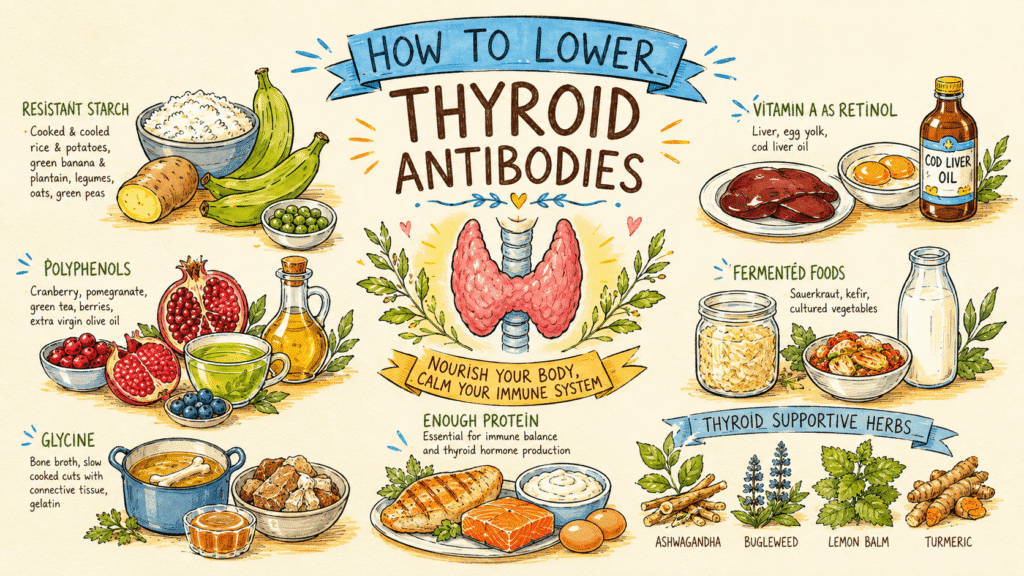
The Foods That Feed the Barrier
Resistant starch. Cooked and cooled rice and potatoes, green banana and green plantain, cooked and cooled legumes, oats, green peas. Gut bacteria ferment these into butyrate, which is the fuel the cells lining the colon actually run on.
Polyphenols. Cranberry, pomegranate, green tea, berries, extra virgin olive oil. These raise the bacteria that maintain the mucus layer, including the Akkermansia mentioned above, without buying anything.
Glycine. Bone broth, slow cooked cuts with connective tissue, gelatin. The most abundant amino acid in the gut lining.
Vitamin A as retinol. Liver, egg yolk, cod liver oil. Needed for the antibody layer that sits inside the mucus. Beta carotene from plants converts poorly in many people.
Fermented foods. Sauerkraut, kefir, cultured vegetables. A reaction to these usually points to histamine sensitivity and is not a sign of failure, but they can be omitted until this piece is addressed.
Enough protein
Everything the lining rebuilds itself from comes out of it.
This is the one people cut without meaning to.
The common mistake runs the opposite direction.
People eliminate their way into a very narrow diet, which strips out fiber variety and often protein, and then wonder why nothing improves.
It is possible to restrict your way into having less to work with than you started with.
Removal has its place. But the lining rebuilds itself every few days, and it needs materials to do it.
There is much more on the barrier itself in the article on how to fix leaky gut, including what breaks it down, ranked by evidence.
How Long Does This Take?
Longer than anyone wants.
The selenium trials measured change at three and six months. The cordyceps analysis pooled studies of similar length. The aloe observation ran nine months, with the first shift appearing at three. The gluten free studies ran for months, not weeks.
So three months is the earliest honest recheck. Six is better. Anyone promising a different number is not reading the same research.
Antibodies also fluctuate on their own, which means a single retest is a snapshot rather than a verdict. Two readings a few months apart tell you more than one.
Where to Start
For anyone asking how to lower thyroid antibodies and wanting one place to begin, a supplement is not it.
Test selenium status rather than assuming, since the entire evidence base rests on correcting a deficiency.
Look honestly at gluten for three months, given that it is the one gut intervention with an antibody meta-analysis behind it.
Build the foods above into the week before adding anything to the cabinet.
Then selenium, then cordyceps, then the rest, one at a time and far enough apart to know which one did something.
The antibodies are not the condition itself.
They are the visible edge of an immune process, and that process lives substantially in the gut.
Learning how to lower thyroid antibodies is really a question of what is keeping that process switched on.
References
Wang F, et al. The effect of selenium supplementation on thyroid autoimmunity: a systematic review and meta-analysis. Thyroid, 2024. https://pubmed.ncbi.nlm.nih.gov/38243784/
Zheng H, et al. Cordyceps in the treatment of Hashimoto’s thyroiditis: a systematic review and meta-analysis of randomized controlled trials. https://pubmed.ncbi.nlm.nih.gov/40166676/
Farhangi MA, et al. The effects of Nigella sativa on thyroid function, serum VEGF, Nesfatin-1 and anthropometric features in patients with Hashimoto’s thyroiditis. BMC Complementary and Alternative Medicine, 2016. https://pubmed.ncbi.nlm.nih.gov/27852303/
Nordio M, Basciani S. Myo-inositol plus selenium supplementation restores euthyroid state in Hashimoto’s patients. European Review for Medical and Pharmacological Sciences, 2017. https://pubmed.ncbi.nlm.nih.gov/29164554/
Efficacy of myo-inositol combined with selenium in autoimmune thyroiditis: a meta-analysis with trial sequential analysis, 2026. https://pubmed.ncbi.nlm.nih.gov/41403332/
Metro D, et al. Marked improvement of thyroid function and autoimmunity by Aloe barbadensis miller juice in patients with subclinical hypothyroidism. Journal of Clinical and Translational Endocrinology, 2018. https://www.sciencedirect.com/science/article/pii/S2214623717301126
Kucukemre Aydin B, et al. Children with Hashimoto’s thyroiditis have increased intestinal permeability: results of a pilot study. Journal of Clinical Research in Pediatric Endocrinology, 2020. https://pubmed.ncbi.nlm.nih.gov/31990165/
Serum zonulin levels in hypothyroid and euthyroid patients with Hashimoto’s thyroiditis: a pilot study. https://pmc.ncbi.nlm.nih.gov/articles/PMC9206160/
Detection of alterations in the gut microbiota and intestinal permeability in patients with Hashimoto thyroiditis. https://www.ncbi.nlm.nih.gov/pmc/articles/PMC7973118/
Cross-talk between the gut microbiota and hypothyroidism: a bidirectional two-sample Mendelian randomization study. Frontiers in Nutrition, 2024. https://pmc.ncbi.nlm.nih.gov/articles/PMC10982496/
Everything shared here reflects study and practitioner experience as a Certified Holistic Health Practitioner. It is offered for education and is not medical advice. Nothing here is intended to diagnose or address any condition. Please consult your own qualified practitioner before making changes to your routine.