
Most of us grew up being told that carrots are good for your eyes because they contain vitamin A.
That is technically true and also deeply misleading.
What carrots contain is beta carotene, which is a precursor to vitamin A.
Your body still has to convert it. And for a significant portion of the population, that conversion is so inefficient it barely registers.
This is the piece of the vitamin A conversation that almost nobody is talking about.
And it matters enormously, especially if you are dealing with chronic fatigue, hormonal disruption, poor skin, immune challenges, or any of the issues that tend to cluster together in people with a history of chronic illness.
The keyword that unlocks this whole conversation is beta carotene vs retinol.
They are not the same thing.
They do not behave the same way in the body.
And understanding the difference may change how you think about food entirely.
What Is Retinol?
Retinol is true preformed vitamin A. It is the form your body can use directly without any conversion step.
It goes to work immediately supporting immune function, skin integrity, vision, hormone production, and the synthesis of proteins involved in cellular growth and repair.
Retinol is found exclusively in animal foods.
There is no plant source of preformed retinol.
This is a hard biochemical fact that gets softened and blurred constantly in mainstream nutrition messaging, and the consequences of that blurring are showing up in the health of people who have been eating plant-heavy diets for years, thinking their vitamin A needs were covered.
What Is Beta Carotene and Why Is It Not Enough?
Beta carotene is a carotenoid pigment found in orange, yellow, and dark green plant foods.
Your body can theoretically convert it into retinol using an enzyme called beta-carotene 15,15′-monooxygenase.
The key word there is theoretically.
Research has documented that the conversion rate is highly variable and often very poor. Some studies suggest the conversion ratio can be as low as 28 to 1, meaning you would need to consume 28 units of beta carotene to produce 1 unit of usable retinol.
Other research puts it even lower depending on the individual.
The people most likely to have impaired beta carotene conversion include those with hypothyroidism or sluggish thyroid function, those with gut malabsorption issues including leaky gut, small intestinal bacterial overgrowth, or chronic parasitic burden, those with certain genetic variants in the BCMO1 gene which codes for the conversion enzyme, those with liver burden or compromised bile production, and people who are chronically stressed since cortisol disrupts the conversion pathway.
If you look at that list and recognize yourself or your health history in it, you may have been functionally vitamin A deficient for years while eating what appeared on paper to be a nutrient-rich diet.
What Weston A. Price Documented
In the 1930s, a dentist named Weston A. Price traveled the world studying the diets and physical health of traditional cultures that had not yet adopted Western processed foods. What he found was remarkable and at the time deeply uncomfortable for mainstream nutrition.
The healthiest populations he observed, with the best bone structure, dental health, immunity, and reproductive outcomes, were consistently eating diets rich in animal fats and organ meats.
Cod liver oil, butter, liver, and full fat dairy were staples. Not optional additions. Foundational foods.
Price documented that when these same populations adopted Western diets and replaced their animal fat-rich traditional foods with white flour, sugar, and vegetable oils, physical degeneration followed within one generation.
Narrowed jaw structure, crowded teeth, increased susceptibility to infection, and reduced fertility were among the documented changes.
His work, published in the book Nutrition And Physical Degeneration, remains one of the most thorough and visually documented arguments for the nutritional superiority of traditional animal-based foods.
The fat-soluble vitamins A, D, and K2 that he called activators are central to his framework. Retinol is at the top of that list.
If you have not read this book, I cannot recommend it strongly enough. It is one of those reads that genuinely shifts how you see food and health.
Beta Carotene vs Retinol: The Key Differences
The beta carotene vs retinol distinction comes down to a few things worth understanding clearly.
Retinol is immediately bioavailable. Beta carotene requires conversion. Retinol supports immune function, skin integrity, and hormone production in ways that are well documented.
Beta carotene functions primarily as an antioxidant in its unconverted form and does not carry out the same physiological roles as retinol. Retinol is fat soluble and stored in the liver.
Beta carotene consumed in excess tends to accumulate in fat tissue and can cause a yellowing of the skin called carotenemia, which is harmless but often misread as a sign of vitamin A adequacy.
True vitamin A toxicity from retinol is possible but far less common than often claimed and almost exclusively associated with isolated synthetic supplements taken in very high doses over long periods, not from whole food sources.
Traditional populations consuming organ meats and cod liver oil daily did not develop vitamin A toxicity.
Their health outcomes pointed in the opposite direction entirely.
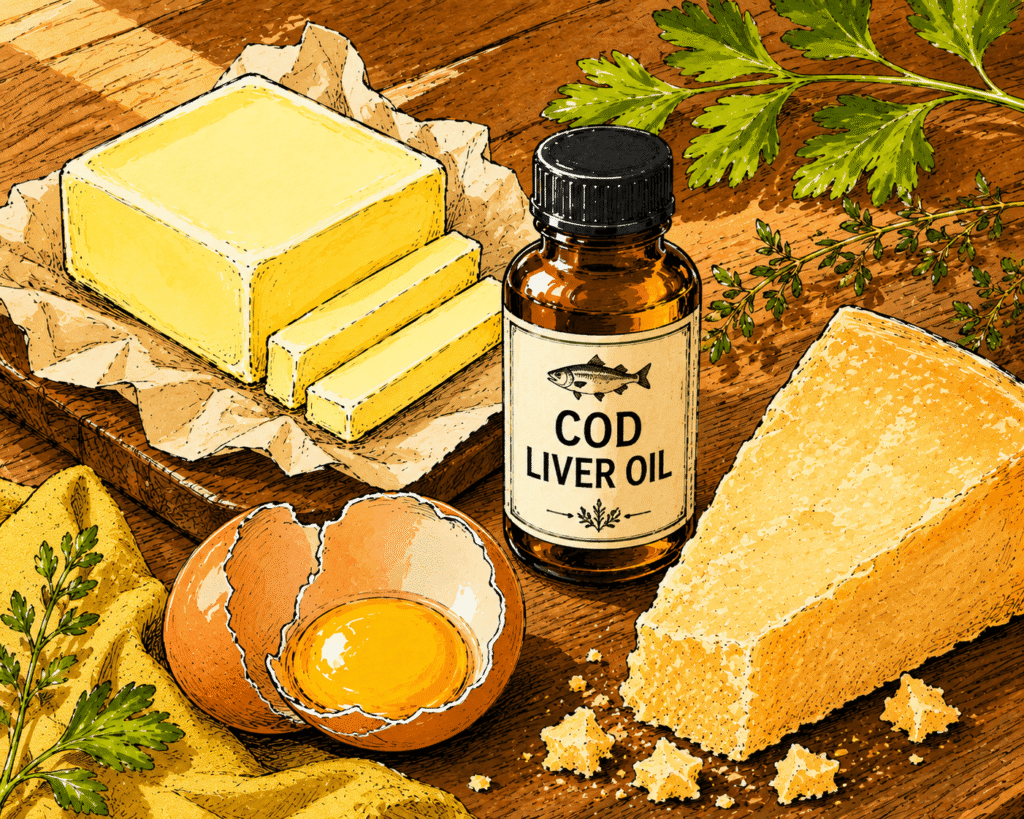
Retinol Rich Foods
The widget I created below shows the foods that provide true preformed retinol in meaningful amounts. Sourcing matters enormously for all of these.
A factory-farmed egg and a pasture-raised soy and corn free egg are not nutritionally equivalent.
Grass fed butter and conventional butter are not the same.
The animals that are eating their natural diet and living in natural conditions concentrate fat-soluble vitamins in their tissues and fat. Animals raised on grain in confinement do not.
Retinol Rich Foods: Real Vitamin A Your Body Can Actually Use
Animal sources only — beta carotene from plants is not the same thing
Beef Liver
Highest known source — grass fed only
Cod Liver Oil
Fermented for best absorption
Chicken Liver
Pasture raised only
Egg Yolks
Pasture raised — conventional eggs are low
Grass Fed Butter
Raw or cultured is best
Aged Cheese
Grass fed full fat only
Sardines
Wild caught, packed in olive oil
Whole Milk
Grass fed, full fat, raw if possible
Lamb Liver
Pasture raised — often more tolerable than beef liver
Why Retinol Matters for Iron Movement
If you read my article on how to move iron in the body, you already know that ceruloplasmin is the copper-carrying enzyme that allows iron to be loaded onto red blood cells and transported through the body.
What that article touched on but did not fully unpack is that retinol is required for ceruloplasmin production.
The liver needs adequate retinol to synthesize ceruloplasmin properly.
Without it, even if copper intake is sufficient, ceruloplasmin output can be impaired and iron movement suffers downstream.
This is one of the reasons that grass fed beef liver is such a powerful food for anyone dealing with iron dysregulation.
It provides retinol, bioavailable copper, and heme iron all in the same package, along with the B vitamins needed to build healthy red blood cells.
The whole food matrix does what no combination of isolated supplements can fully replicate.
Why Retinol Matters for Hormonal Health
Retinol supports the production of sex hormones including progesterone and testosterone.
It is involved in the synthesis of thyroid hormone and the conversion of T4 to the active T3 form.
It supports the integrity of mucosal tissue throughout the reproductive and digestive systems.
Women dealing with estrogen dominance, low progesterone, irregular cycles, or fertility challenges are often found to have low retinol status.
The conventional advice to eat more orange vegetables is not going to move the needle for someone whose conversion pathway is compromised.
Getting retinol from actual animal sources is where the shift happens.
Why Retinol Matters for Skin and Immunity
The skin connection is the one most people are already somewhat familiar with since the pharmaceutical form of vitamin A, tretinoin, is widely prescribed for acne and skin aging.
What most people do not know is that the mechanism behind why vitamin A works for skin is a retinol mechanism, not a beta carotene one.
Retinol supports the differentiation and growth of epithelial cells, which make up the skin and all mucosal linings in the body.
It supports the production of mucus that protects these surfaces from pathogens.
It is involved in the production of antimicrobial peptides that are part of the innate immune response.
A person who is functionally retinol deficient may experience chronic skin issues, recurring infections, poor wound healing, and a generally sluggish immune response that does not resolve no matter how many supplements they add to their protocol.
The Cod Liver Oil Connection
Fermented cod liver oil has been one of the most consistently recommended foods in traditional and ancestral health circles for a reason.
It provides retinol and vitamin D together in their natural ratio, which is important because these two fat-soluble vitamins work synergistically and their balance matters as much as their individual levels.
Weston Price observed that the populations with the best health outcomes consumed foods that were high in what he called activators, and cod liver oil was one of the most concentrated sources he identified.
Traditional cultures from Norway to Japan to the Scottish Hebrides used fermented or traditionally processed fish liver oils as a foundational health food, particularly for pregnant women, growing children, and anyone who was unwell.
Adding a high quality fermented cod liver oil to a daily protocol alongside grass fed beef liver covers the retinol and fat-soluble vitamin needs in a way that is deeply aligned with how humans have eaten for most of our history.
Getting Practical
For anyone who wants to shift their retinol status through food, the starting point is simple.
Add grass fed beef liver or a high quality desiccated grass fed liver supplement if you cannot stomach eating liver directly.
Add fermented cod liver oil daily.
Cook with grass fed ghee or butter rather than vegetable oils.
Prioritize pasture-raised corn and soy free eggs over conventional.
Add full fat grass fed dairy if you tolerate it.
These are not complicated changes.
They are a return to the way people ate before the low fat era told us to fear animal foods and swap butter for margarine and organ meats for breakfast cereal.
The physical degeneration Price documented when those swaps were made is well worth taking seriously.
Stop relying on beta carotene from plants to cover a need that only retinol can fill.
The beta carotene vs retinol distinction is not a minor nuance.
For many people it is the missing piece that explains why they have been doing everything right on paper and still not feeling the way they want to feel.