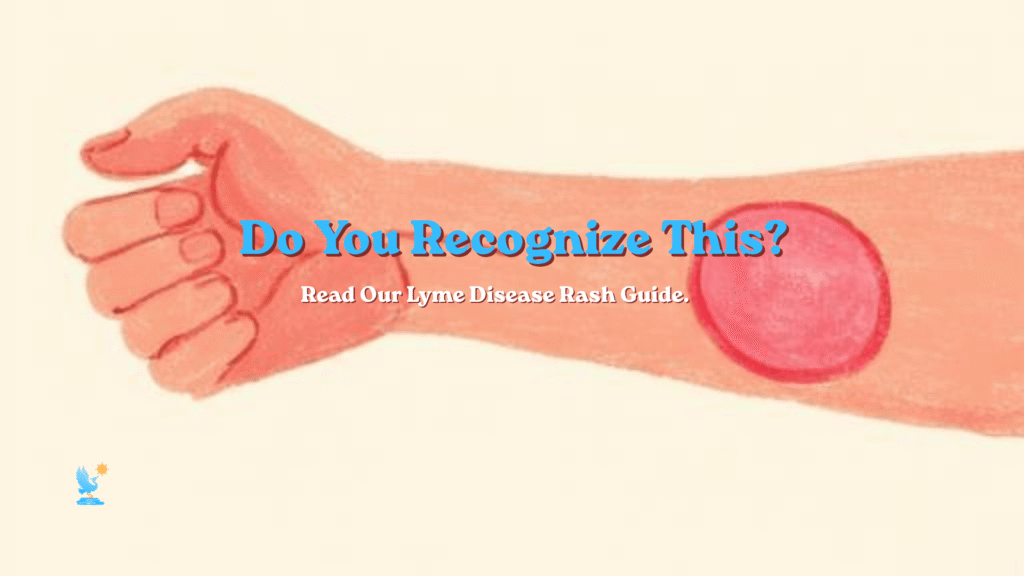

Just found a tick? This is the first herb that integrative Lyme practitioners reach for after a bite.
You found a tick.
Or maybe you never found one at all.
But now there is something on your skin that does not look right and you are wondering if it could be a lyme disease rash.
The truth is, the lyme disease rash is one of the most misidentified and most missed signs in all of medicine.
Some people get the textbook bull’s eye.
Most do not.
And by the time people realize something is wrong, the window for early treatment has often already closed.
This guide will walk you through exactly what a lyme disease rash looks like in its many forms, what it means for your health, and what natural steps you can take to support your body whether you caught it early or you are already months into unexplained symptoms.
If you have already been diagnosed and are looking for a full natural recovery protocol, make sure to read our companion article: Natural Remedy for Lyme Disease: A Holistic Recovery Guide at dodhisattva.com, where we go deep into the full treatment approach used by experienced integrative Lyme practitioners.
🌿 Lyme Disease Rash: What Is Your Situation?
This tool is for educational purposes only and does not constitute medical advice. It is designed to help you understand what you may be observing. Always consult a qualified healthcare practitioner for personal guidance.
- Contact your healthcare provider today and mention the tick bite date and location
- Photograph the rash daily so your provider can track how it is changing
- Note any accompanying symptoms including fever, fatigue, or muscle aches
- Do not wait to see if it resolves on its own
- Read our full guide: Lyme Disease Rash: What It Really Looks Like
This tool is for educational purposes only and does not constitute medical advice. Always consult a qualified healthcare practitioner for personal guidance.
- Photograph the rash and note whether it is expanding
- Contact a healthcare provider and specifically mention tick exposure
- Share with your provider that the rash does not follow the classic bull's eye pattern — photographs will help
- Ask about comprehensive Lyme evaluation including co-infection screening
- Read our full guide: Lyme Disease Rash: What It Really Looks Like
This tool is for educational purposes only and does not constitute medical advice. Always consult a qualified healthcare practitioner for personal guidance.
- Contact a healthcare provider today — do not wait
- Photograph all rashes and note their locations on your body
- Ask specifically about early disseminated Lyme disease
- Request comprehensive testing including co-infection panels
- Read our full guide: Lyme Disease Rash: What It Really Looks Like
This tool is for educational purposes only and does not constitute medical advice. Always consult a qualified healthcare practitioner for personal guidance.
- Contact your healthcare provider and mention the tick bite and your symptoms
- Keep a written log of your symptoms including when they started and how they change
- Ask about Lyme testing — note that standard testing has sensitivity limitations in early infection
- Ask about co-infection screening alongside standard Lyme testing
- Read: Tick Bite Symptoms: What to Watch For
This tool is for educational purposes only and does not constitute medical advice. Always consult a qualified healthcare practitioner for personal guidance.
- Photograph the bite site and check it daily for the next two weeks
- Note any symptoms that develop including fever, fatigue, joint pain, or cognitive changes
- Consider sending the tick for testing if you still have it
- Contact a healthcare provider promptly if any symptoms develop
- Read: What to Do After a Tick Bite: The First 24 Hours and Beyond
This tool is for educational purposes only and does not constitute medical advice. Always consult a qualified healthcare practitioner for personal guidance.
- Photograph the rash today and again each day for the next week
- Note whether the rash appears to be expanding outward
- Contact a healthcare provider and show them your photographs
- Mention any tick exposure or time spent in wooded or grassy areas
- Read our full guide: Lyme Disease Rash: What It Really Looks Like
This tool is for educational purposes only and does not constitute medical advice. Always consult a qualified healthcare practitioner for personal guidance.
What Is the Lyme Disease Rash?
The lyme disease rash, medically called Erythema migrans, is the skin reaction that occurs when the Borrelia burgdorferi bacteria begins spreading from the site of a tick bite.
It typically appears anywhere from 3 to 30 days after a bite.
Here is what most people do not know: only 20 to 30 percent of people infected with Lyme ever develop the classic bull’s eye pattern at all.
And there is an important reason for this.
The lyme disease rash only appears when Borrelia is in its spirochete form at the time of transmission.
If the bacteria has shifted into another form such as a cyst, no rash will appear at all.
Borrelia is a highly adaptable bacteria that can exist in four distinct forms:
- The spirochete form, which is the corkscrew-shaped version that most people picture when they think of Lyme
- The cyst-like form, where the bacteria rolls itself into a protective rounded ball that is very difficult to treat
- The intracellular form, where it enters cells directly and wreaks havoc from the inside
- The biofilm form, where it surrounds itself in a protective matrix that shields it from both the immune system and antimicrobial treatment
This is why so many people are misdiagnosed and why understanding every variation of the lyme disease rash matters so much.
Only 20 to 30 percent of people infected with Lyme ever develop the classic bull's eye rash. The rash only appears when Borrelia is in its spirochete form at transmission. If it has shifted into a cyst, intracellular, or biofilm form no rash will appear at all. Absence of a rash does not mean absence of infection.
Lyme Disease Rash Pictures
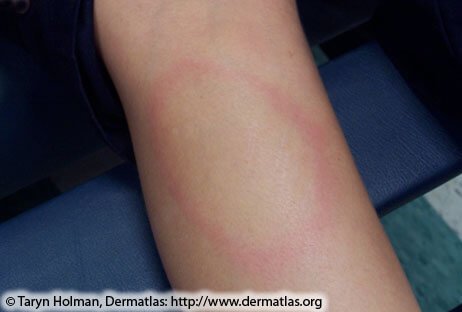
More Lyme Disease Rash Pictures
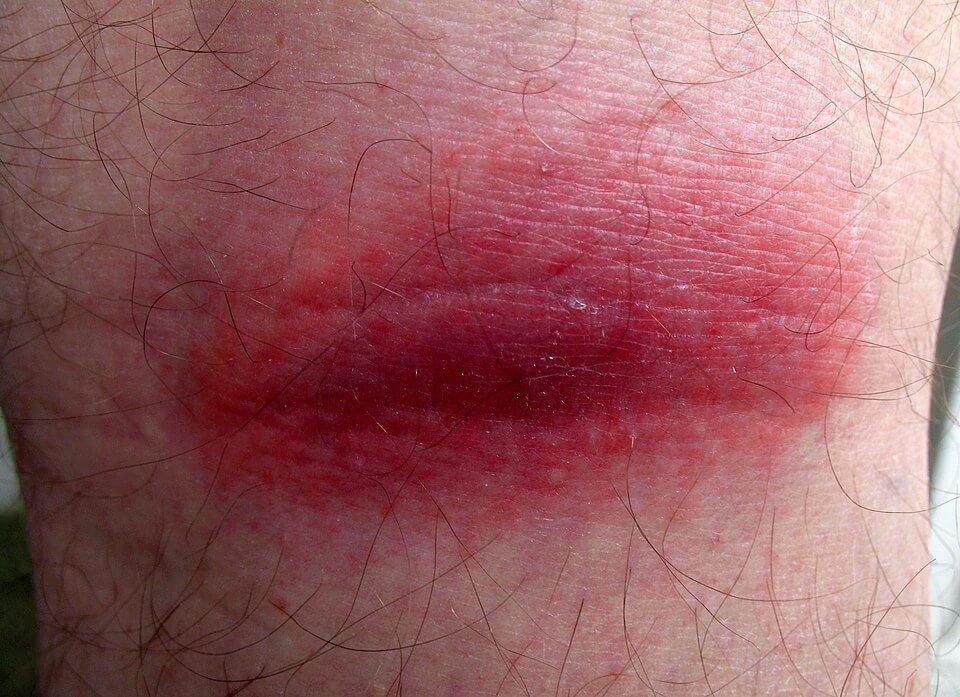
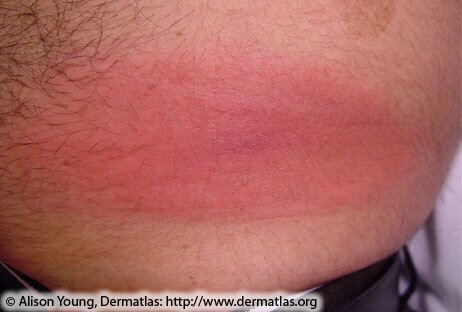
Atypical erythema three days after removal of a Borrelia-positive tick from the hollow of the knee. Image by Túrelio via Wikimedia Commons, CC BY-SA 3.0.
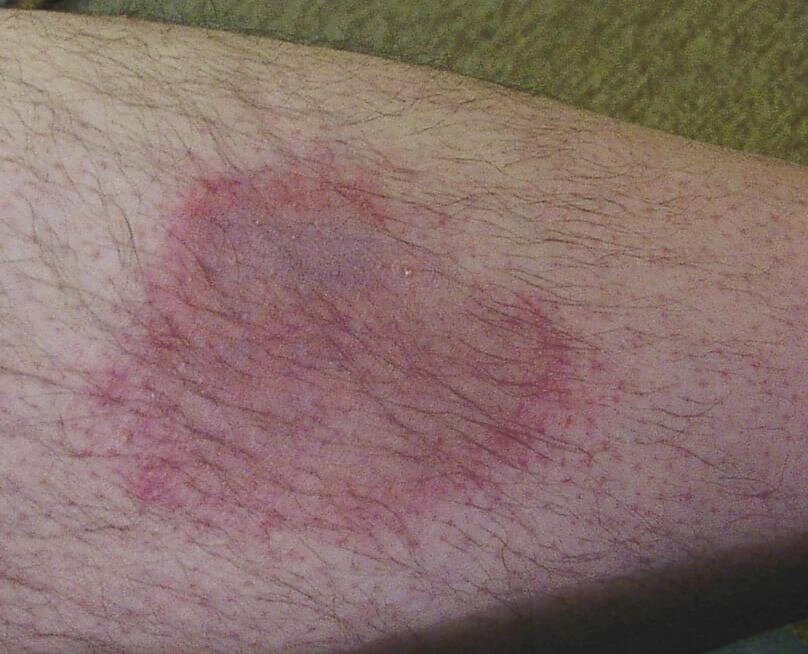
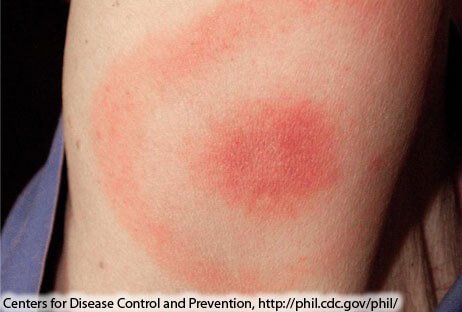
Erythema migrans at the lower leg following a Borrelia tick infection. Image by Jost Jahn, CC BY-SA 2.0 DE, via Wikimedia Commons.
What Does a Lyme Disease Rash Look Like? Every Variation
The lyme disease rash can appear in several distinct forms and very few of them look like the textbook image:
1. The Classic Bull’s Eye Rash
- Appears as a red outer ring with a clear or pale center and a red bull’s eye in the middle
- Gradually expands outward, sometimes reaching 12 inches or more in diameter
- Usually flat rather than raised, and warm to the touch but rarely painful or itchy
- Most commonly appears on the thigh, groin, armpit, or back of the knee
2. Solid Red Oval or Expanding Patch
This is the most commonly missed lyme disease rash. It looks like:
- A uniform red or pink oval with no bull’s eye pattern at all
- A slowly growing red patch that might be mistaken for a sunburn, hives, or allergic reaction
- Often misidentified as ringworm or cellulitis
3. Multiple Lyme Disease Rashes
In some cases Borrelia spreads through the bloodstream and causes multiple lyme disease rashes to appear on different parts of the body at the same time, not just at the original tick bite site.
This is a sign the infection has already begun spreading systemically.
4. No Rash At All
The majority of people with Lyme disease never develop any visible rash.
The bacteria may have been transmitted in a non-spirochete form, the rash may have appeared somewhere hidden like the scalp or back, or it may have faded before anyone noticed.
This is one of the primary reasons Lyme is so frequently undiagnosed.
Where Does the Lyme Disease Rash Appear on the Body?
Ticks prefer warm, moist, hidden areas of the body. The lyme disease rash most commonly appears:
- Behind the knees
- In the groin and inner thighs
- In the armpits
- On the scalp or hairline
- Around the waistband
- On the back or buttocks
Because ticks are tiny, sometimes no bigger than a poppy seed in the nymph stage, many people never feel the bite and never notice the lyme disease rash before it fades.
Lyme Disease Rash Timeline: How Long Does It Last?
- Days 1 to 3 after the bite: No rash yet. The bacteria are beginning to multiply at the bite site.
- Days 3 to 30: The lyme disease rash begins to emerge and slowly expands outward.
- Weeks 1 to 4: The rash may reach its largest size, sometimes several inches across.
- Without treatment: The rash typically fades on its own within 3 to 4 weeks. This does NOT mean the infection is gone. Borrelia has simply moved deeper into the body and shifted form.
The disappearance of the lyme disease rash is one of the most dangerous misconceptions in Lyme disease.
People assume they are better when in reality the bacteria has gone systemic.
The rash typically fades on its own within 3 to 4 weeks without treatment. This does NOT mean the infection is gone. Borrelia has simply moved deeper into the body and shifted form. The disappearance of the Lyme disease rash is one of the most dangerous misconceptions in Lyme disease.
Symptoms That Accompany the Lyme Disease Rash
The lyme disease rash rarely appears alone.
Most people also experience flu-like symptoms in the days and weeks following a tick bite:
Lyme Disease, the Rash, and the Autoimmunity Connection
One of the most important and least discussed aspects of Lyme disease is its ability to trigger autoimmunity.
This is directly connected to Borrelia’s intracellular form.
When Borrelia penetrates cell walls and takes up residence inside your own cells, the immune system recognizes those infected cells as damaged and mounts an attack against them.
Over time this can look indistinguishable from an autoimmune disease.
Conditions like lupus are frequently misdiagnosed in people who are actually dealing with an undetected chronic Lyme infection.
This is why many people with a chronic lyme disease rash history go on to develop what appears to be lupus, rheumatoid arthritis, or other autoimmune conditions.
The root cause in many of these cases is an unresolved Borrelia infection driving the immune system into a state of chronic confusion and self-attack.
Conditions like lupus are frequently misdiagnosed in people who are actually dealing with undetected chronic Lyme infection. When Borrelia enters cells directly the immune system attacks those infected cells as damaged. Over time this becomes indistinguishable from autoimmunity. The root cause in many of these cases is an unresolved Borrelia infection driving the immune system into chronic confusion and self-attack.
Lyme Disease Rash and Co-Infections: What Else Could Be Going On?
The same tick that gives you Lyme can also transmit co-infections like Bartonella and Babesia at the same time.
These co-infections do not typically produce their own distinct rash but they dramatically worsen symptoms and make recovery far more complex.
Bartonella can produce its own distinctive skin marking: linear, stretch mark-like streaks on the skin, often on the thighs or abdomen, that are different from the lyme disease rash but equally important to recognize.
If you are experiencing a lyme disease rash alongside night sweats, air hunger, or extreme mood shifts, co-infections are very likely involved and need to be addressed alongside the Borrelia infection.
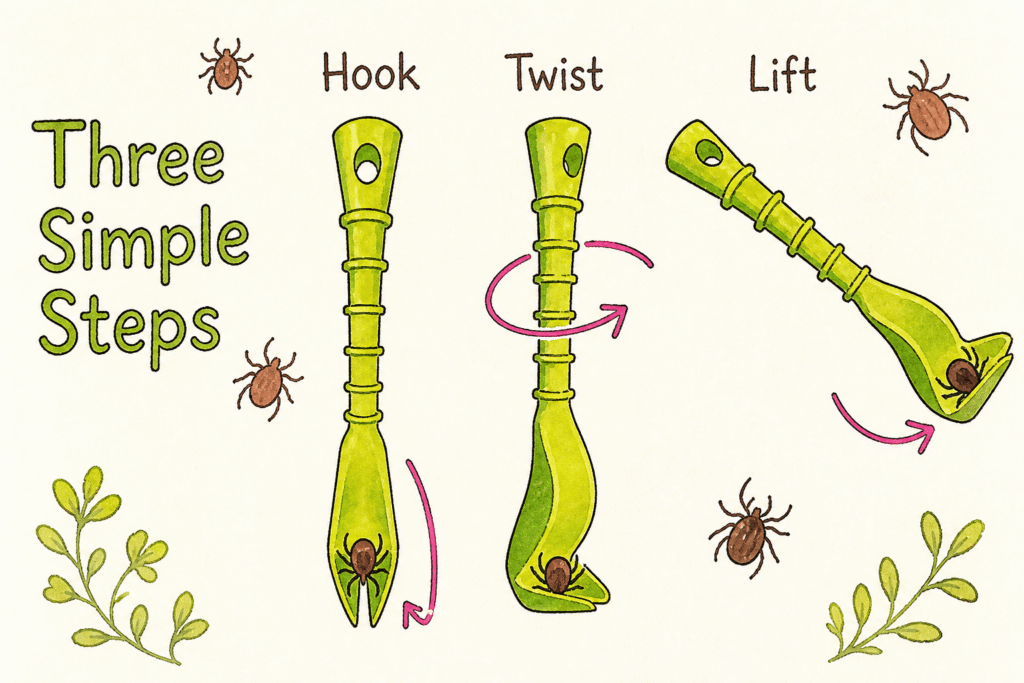
Just Got Bit? Act Fast.
If you have just been bitten and you are watching a lyme disease rash begin to form, this is the moment to move quickly.
Unlike chronic Lyme, where the body needs careful preparation before treatment begins, an acute bite calls for immediate action.
The window to stop Borrelia from gaining a foothold is short and you do not want to waste it.
Here is what integrative Lyme practitioners recommend in the acute phase:
1. Remove the Tick Safely
Use fine-tipped tweezers, grasp as close to the skin as possible, and pull straight up with steady pressure.
Do not twist, squeeze, or try to suffocate the tick with petroleum jelly or heat.
Those methods can cause the tick to regurgitate its contents directly into the wound, increasing your exposure.
Clean the bite with hydrogen peroxide once the tick is removed.
2. Naturopathic protocols suggest applying a Bentonite Clay & Andrographis paste to the bite site
This is a well-known naturopathic first response.
They mention to mix Bentonite clay with Andrographis tincture to form a paste and apply it directly to the bite site.
Andrographis is often researched for its potential to support the body against spirochetes and bentonite clay is traditionally used to support the skin’s natural detoxification process.
Commonly used as a topical application for as long as tolerated.
3. Researching the Immediate Use of Herbal Protocols
Research from Johns Hopkins has explored how certain herbs can support the body in ways that complement traditional approaches.
- Andrographis: one of the most studied anti-spirochetal herbs available
- Cat’s Claw: immune modulating and shown to increase natural killer cells that are commonly deficient in Lyme patients
- Japanese Knotweed: inhibits spirochete growth across multiple developmental stages and is highly anti-inflammatory
- Sweet Wormwood (Artemisia annua): shown in research to have strong activity against Borrelia
- Black Walnut Hull: broad antimicrobial activity against multiple Borrelia form
- Cistus or Rock Rose: This will help break up the biofilms where the bugs like to live. Go slow and start with a cup or two a day.
4. Support Drainage and Immune Function Alongside the Herbs
Even in acute cases, supporting your liver and lymphatic system helps the body process what the herbs are stirring up.
Add Milk Thistle for liver protection and stay well hydrated. This is not about doing a full drainage protocol before you treat.
It is about giving your body the best possible environment to clear the infection quickly.
Already Past the Rash Stage? Chronic Lyme Needs a Different Approach
If the lyme disease rash has already come and gone, or you never had one, and you are now months or years into unexplained symptoms, the approach is fundamentally different from the acute phase.
With chronic Lyme the body is typically carrying multiple burdens at once.
Experienced integrative practitioners often find they need to address parasites, heavy metals, and mold first before the body is ready to respond to Lyme treatment.
Then, based on careful patient testing, the right moment to introduce a targeted Lyme protocol is determined.
Sometimes that is early in the process.
Sometimes it comes later.
It depends entirely on what the individual needs.
We have put together a full guide to this approach here: Natural Remedy for Lyme Disease: A Holistic Recovery Guide at dodhisattva.com.
It covers the complete layered protocol, including drainage support, biofilm disruption, herbal antimicrobials, co-infection treatment, and the right order to do all of it.
How To Prevent a Lyme Disease Rash From Happening in the First Place
- Wear light-colored clothing so ticks are visible
- Tuck pants into socks in wooded or grassy areas
- Do a full body tick check within 2 hours of being outdoors
- Natural tick repellents include rose geranium essential oil, neem oil, and permethrin-treated clothing
- Support your immune system year-round so your body has the resilience to respond if exposure does occur
The Lyme Disease Rash Is a Warning, Not Just a Skin Issue
The lyme disease rash is your body’s first visible signal that something has entered that needs to be addressed.
Whether you catch it in the first week or you are reading this years after an undiagnosed bite, what matters most is what you do next.
Lyme disease is a systemic infection that requires a systemic response.
The body has a profound capacity to heal when it is given the right support in the right order.
That is what we believe at Dodhisattva and it is what every resource on this site is designed to help you do.
DISCLAIMER: This article is for educational purposes only and does not constitute medical advice. The information shared here reflects traditional herbal knowledge and integrative wellness frameworks. Always consult with a qualified healthcare practitioner before beginning any protocol, especially if you suspect a tick-borne illness.
Sources and Further Reading
The information in this article draws on the following peer-reviewed research, clinical resources, and patient advocacy organizations:
- Feng J, et al. Evaluation of Natural and Botanical Medicines for Activity Against Growing and Non-growing Forms of B. burgdorferi. Frontiers in Medicine, 2020. Johns Hopkins Bloomberg School of Public Health.
- Sapi E, et al. The Use of Natural Bioactive Nutraceuticals in the Management of Tick-Borne Illnesses. Microorganisms, 2023. PubMed Central (PMC). https://pmc.ncbi.nlm.nih.gov/articles/PMC10384908/
- Cameron DJ, et al. A Comprehensive Review of Herbal Supplements Used for Persistent Symptoms Attributed to Lyme Disease. PMC, 2023. https://pmc.ncbi.nlm.nih.gov/articles/PMC10124234/
- Project Lyme. Treating Lyme and Other Tick-Borne Infections With Natural Remedies. projectlyme.org
- Project Lyme. Herbal Remedies for Lyme Disease: Acute Bite Protocol. projectlyme.org
- Global Lyme Alliance. Natural Treatment for Lyme Disease. globallymealliance.org
- Columbia University Lyme and Tick-Borne Diseases Research Center. Treatment Options for Lyme Disease. columbia-lyme.org
- IGeneX Tick Talk. Natural Remedies for Lyme Disease. igenex.com