


Rose geranium is one of my favorite botanicals to keep on hand during tick season.
Finding the best natural tick repellent for humans is one of the most searched topics in outdoor wellness right now and for good reason.
People want to enjoy time in nature confidently, without soaking themselves in synthetic chemicals every time they step outside.
The research on plant-based tick repellent options has expanded significantly over the past decade, and the findings are genuinely encouraging.
Certain essential oils and botanical compounds have demonstrated meaningful repellent activity against tick species in peer-reviewed studies, some with efficacy comparable to conventional synthetic repellents at the right concentrations.
This article covers what the science actually says about natural tick repellent, which botanicals have the strongest evidence behind them, important safety considerations, and a simple DIY recipe you can make at home.
Why Natural Tick Repellent Is Worth Knowing About
The best natural tick repellent for humans options have historically been dismissed as less effective than synthetic alternatives like DEET.
That picture is becoming more nuanced as research accumulates.
A peer reviewed study published in Experimental and Applied Acarology by researchers at the University of Bristol found that 5 percent oregano and spearmint essential oils applied to clothing showed meaningful repellent potential in field conditions with known tick populations.
Researchers noted that in these specific field conditions the botanical oils demonstrated repellent potential comparable to the synthetic control used in the study.
Spearmint oil treatments resulted in significantly fewer ticks on both blankets and treated trousers compared to untreated controls, and ticks that did attach to spearmint-treated fabric showed a significantly higher drop-off rate within three minutes compared to untreated surfaces.
A systematic review published in PubMed examining essential oils as repellents against tick species noted the wide diversity and high effectiveness of a number of plant-borne compounds, particularly essential oils extracted from medicinal and aromatic species, and identified this as a prominent and growing area of research.
The honest caveat is that most essential oil repellents wear off more quickly than synthetic options and require more frequent reapplication.
They are best understood as part of a layered approach to tick awareness rather than a single complete solution.
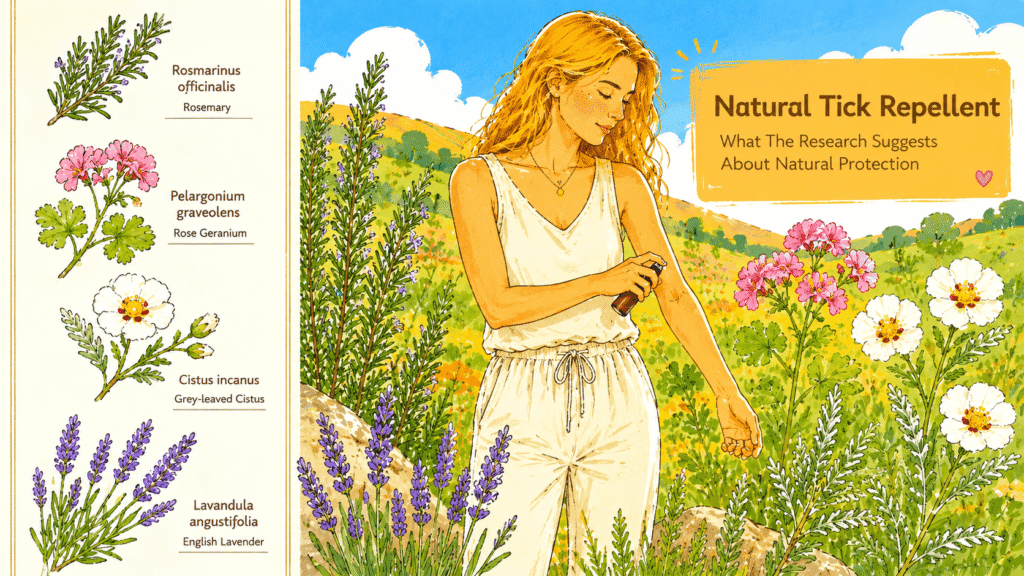
The Best Natural Tick Repellent For Humans Botanicals With the Most Research
Rose geranium, specifically Pelargonium capitatum x radens, is considered by many integrative practitioners to be one of the strongest plant-based options for tick repellency.
Scientific studies have demonstrated repellent efficacy for geranium oil comparable to DEET in some comparative assessments.
A systematic review of essential oil repellency against ticks.
It works in part by masking the carbon dioxide signals that draw ticks toward a host.
Note that rose geranium is botanically distinct from standard geranium essential oil.
For tick-related purposes, rose geranium is the specific variety that has been studied and referenced most consistently.
Spearmint and Oregano
As noted in the University of Bristol field research, spearmint and oregano oils at 5 percent concentration on clothing showed meaningful reduction in tick contact and attachment in real-world tick habitat conditions.
Oregano oil contains carvacrol, a compound that has been studied for its activity against a range of organisms.
Both oils should always be diluted before skin application as they can be irritating at full strength.
Cedarwood
Cedarwood oil contains cedrol, a compound that research has found triggers an avoidance response in ticks.
It is one of the more commonly used botanicals in natural tick-focused products and has a long history of traditional use as an insect deterrent.
Cedar chips and cedar mulch around garden beds and lawn perimeters are also traditionally used to create natural tick barriers in outdoor environments.
Lemongrass
Research found that lemongrass essential oil and its main chemical constituents including geraniol, citronellol, and citral were significantly repellent to Ixodes scapularis nymphs, the deer tick species most associated with Lyme disease transmission in the United States.
The efficacy of lemongrass essential oil was dose related and was observed to repel up to 76 percent of nymphs after 10 minutes at the highest tested concentration.
As with most essential oil repellents the effect diminished over time, reinforcing the need for regular reapplication.
Oil of Lemon Eucalyptus
Oil of lemon eucalyptus is distinct from standard eucalyptus oil and has been studied more extensively than most plant-based repellent options.
Its active compound PMD has demonstrated repellent activity against certain tick species in comparative studies and is one of the few plant-derived compounds that has received broader recognition for its documented efficacy.
It should be noted that oil of lemon eucalyptus is not recommended for children under three years of age.
Neem
Neem oil has a long history of traditional use as a natural pest deterrent and research has supported its activity against tick larvae.
It has a strong distinctive odor that many people choose to mask by blending it with other carrier oils or essential oils.
Neem is considered one of the broader spectrum botanical options in natural tick-aware protocols.
Natural Tick Repellent for Your Environment
Beyond personal application, certain plants in and around the home and garden are traditionally associated with deterring insects and ticks.
Lavender, rosemary, and marigolds planted around the perimeter of a lawn or garden are commonly used in this way.
Research from Farmers Almanac and integrative gardening sources notes that approximately 82 percent of ticks found on residential lawns are within nine feet of the lawn perimeter, particularly where lawn borders wooded areas, stone walls, or dense plantings.
Creating clear boundaries between lawn and wooded edges, adding wood chips or gravel along those edges, removing leaf litter, and maximizing sunny areas all reduce the habitat conditions ticks prefer.
Cedarwood chips and cedar mulch used in landscaping are also traditionally employed as environmental tick deterrents.

DIY Natural Tick Repellent Body Oil Recipe
This recipe uses jojoba oil as the carrier base, which is one of the best options for skin application.
Jojoba closely mimics the skin’s natural sebum, absorbs easily without leaving a greasy residue, has a long shelf life, and is rich in antioxidants.
Fractionated coconut oil is an equally good alternative and stays liquid at all temperatures unlike regular coconut oil.
Neither of these is a seed oil, both are stable, skin-nourishing, and suitable for use as a repellent base.
What you need:
2 ounces of jojoba oil or fractionated coconut oil
10 drops rose geranium essential oil
10 drops cedarwood essential oil
10 drops lemongrass essential oil
5 drops spearmint or oregano essential oil
A dark glass bottle or roller bottle for storage
How to make it:
Combine the carrier oil and all essential oils in the dark glass bottle.
Cap tightly and roll gently between your palms to blend.
Store in a cool dark place away from direct sunlight.
This blend will last approximately three months stored properly.
How to use it:
Apply to exposed skin areas before going outdoors, focusing on ankles, wrists, behind the knees, and the back of the neck.
Reapply every two to three hours or after swimming or sweating.
Always do a patch test on a small area of skin before wider application.
Do not apply to broken skin or near eyes and mouth.
Keep away from children under three years of age.
This recipe produces a concentration of approximately 5 to 6 percent essential oils in the carrier base, which aligns with the concentration ranges used in research showing meaningful repellent activity.
Never apply undiluted essential oils directly to skin. This blend is intended for educational exploration of botanical scents and is not a substitute for professional medical advice or EPA-registered products in high-risk areas.
🌿 Natural Tick Repellent Recipes
Choose your recipe below and follow along
- 2 oz jojoba oil or fractionated coconut oil
- 10 drops rose geranium essential oil
- 10 drops cedarwood essential oil
- 10 drops lemongrass essential oil
- 5 drops spearmint or oregano essential oil
- Dark glass bottle or roller bottle
- 1. CombineThe carrier oil and all essential oils are added to the dark glass bottle.
- 2. BlendThe bottle is capped tightly and rolled gently between the palms to blend the oils together.
- 3. StoreThe blend is stored in a cool dark place away from direct sunlight. The mixture keeps for approximately 3 months stored properly.
- 3 oz witch hazel
- 1 oz distilled water
- 15 drops spearmint essential oil
- 15 drops oregano essential oil
- 10 drops cedarwood essential oil
- Small dark glass spray bottle
- 1. CombineThe witch hazel and distilled water are poured into the spray bottle.
- 2. Add OilsThe essential oils are added to the bottle.
- 3. ShakeThe bottle is capped tightly and shaken well before each use as the oils and liquid will naturally separate between applications.
- 4. ApplyThe spray is applied to clothing including trouser cuffs, socks, jacket sleeves, and hat before entering tick habitat. The fabric is allowed to dry fully before wearing.
Cistus Incanus Tea: Natural Tick Repellent From the Inside Out
One of the most fascinating and underappreciated approaches to natural tick repellent is internal rather than topical.
Cistus incanus, also known as Mediterranean rock rose, is a flowering plant native to warm Mediterranean regions including Crete in Greece, Sardinia in Italy, and Turkey.
It has been used for centuries in traditional European herbal medicine and has more recently gained attention in integrative health communities for its potential role as an internal tick deterrent.
The proposed mechanism is that cistus contains volatile oils, polyphenols, gallic acid, catechins, and bioflavonoids that when consumed regularly are metabolized and excreted through the skin.
Literature and traditional use suggest it may help support a scent profile that is less attractive to biting insects.
A notable German study examined dogs given cistus incanus daily and found they received significantly fewer tick bites than dogs that were not given the herb.
Anecdotal reports from practitioners and individuals who drink the tea regularly during tick season are consistent with this finding, with many describing dramatically fewer encounters with ticks after establishing a consistent cistus tea practice.
Hobby Farms notes that while formal research on cistus as an internal insect repellent remains limited, the anecdotal accounts from regular tea drinkers make incorporating it during tick season a reasonable consideration for those interested in botanical approaches to tick awareness.
Cistus incanus tea has a mild, slightly floral and astringent quality similar to black tea.
It is caffeine free and is generally consumed as two to three cups daily for at least a week before expecting any potential repellent benefit to establish, as the effect appears to build with consistent use rather than appearing immediately.
Beyond its potential natural tick repellent properties, cistus incanus is also studied for its antioxidant activity, immune supporting properties, anti-biofilm activity, and oral health benefits, making it a genuinely useful botanical for overall wellness during time spent outdoors.
Research from Johns Hopkins Bloomberg School of Public Health on Cistus.
Cistus incanus tea can also be prepared as a strong decoction and poured into a spray bottle for topical application on skin or clothing, providing a dual use option for those who enjoy this botanical.
Garlic: The Internal Tick Repellent With the Strongest Human Trial Data
Garlic is the internal tick repellent option with the most robust human research behind it and it is worth understanding what the evidence actually shows.
The Swedish military conducted a randomized controlled double-blind trial examining garlic as a tick repellent among marines.
Participants who consumed the equivalent of approximately one clove of garlic daily showed a significant reduction in tick bites compared to those taking a placebo, with the garlic group experiencing approximately 20 percent fewer tick bites.
This is a meaningful finding because it comes from a proper randomized controlled trial published in JAMA rather than anecdotal observation, which places it at a higher level of evidence than most natural repellent research.
A 20 percent reduction in tick bites is not complete protection and should be understood as a supportive measure rather than a standalone solution.
However, it is a documented and real effect from a food that most people already have access to and consume regularly.
Laboratory research published in PMC examined garlic extract against tick species and found it produced repellency indices of up to 87 percent at higher concentrations in controlled settings, with the repellent activity occurring primarily through deterrence rather than avoidance.
The proposed mechanism for garlic’s internal repellent effect is similar to that of cistus.
Compounds in garlic, particularly allicin and its derivatives, are metabolized and excreted through the skin, creating an odor profile that is detectable by ticks and other insects at a level below what human noses typically perceive.
Consuming fresh garlic daily, incorporating it generously into food, or taking a garlic supplement during tick season are all ways individuals integrate this botanical into their approach to tick awareness.
Garlic consumed internally should be distinguished from garlic oil applied topically.
Research has indicated that topical garlic application loses its repellent effect relatively quickly, while the internal consumption route appears to produce a more sustained systemic effect through metabolic excretion.
As with all approaches in this article, garlic as an internal tick repellent is a supportive layer within a broader strategy and not a substitute for other protective measures.
No discussion of the best natural tick repellent for humans is complete without addressing clothing.
Clothing is arguably the most reliable and completely non-toxic layer of protection available and it works synergistically with any botanical repellent approach.
Wearing light colored clothing makes ticks visible before they reach skin, giving you the opportunity to brush them off.
Ticks are dark in color and stand out clearly against white, cream, or light grey fabric.
Tucking trousers into socks when walking in tall grass, wooded areas, or known tick habitat is one of the most effective single actions a person can take.
Ticks cannot fly or jump.
They quest from vegetation by holding on with their back legs and reaching out with their front legs to grasp a passing host.
Tucked trousers eliminate the gap between sock and trouser leg that gives ticks direct access to skin.
Long sleeves with fitted cuffs and a hat when in tick habitat areas reduce the surface area of exposed skin available for tick access.
Applying the essential oil clothing spray recipe from this article to trouser cuffs, socks, jacket sleeves, and hat adds a botanical repellent layer directly to the areas ticks most commonly access from vegetation.
A bandana can be worn around your neck to cover this area.
After time outdoors, putting clothing directly into a dryer on high heat for ten minutes before washing is a practical way to address any ticks that may have hitched a ride on fabric before they have the opportunity to reach skin.
Beyond Repellents: Awareness as Prevention

The best natural tick repellent for humans is not always something you apply to your skin.
Sometimes it is simply attention.
I do not live in a tick habitat area but I visit family and friends who do, and these are the personal practices I build into any time outdoors in tick country.
I put my phone away and stay present in my body.
You will notice the tickle on your skin or the sensation that you would otherwise scroll right past.
I carry this lint roller in my backpack and use it when I get back in after being in tick habitat.
You can simply roll over your clothing and have someone get your back if you’re with someone.
I always have a Tick Tornado in my bag, and I know how to use it before I need it.
Staying calm in the moment starts with being prepared before the moment arrives.
I check the dogs before getting back in the car, focusing on the face, ears, underbelly, and between the toes.
When I get home, I remove clothing in the mudroom or exterior space before entering the main living area and dry on high heat for ten minutes before washing.
I drink cistus tea consistently through tick season as an internal botanical support practice.
And it is very important to eat a healthy, whole food organic diet.
If you eat a processed and sugar-laden diet, bugs will love your skin!
And I keep my vitamin D levels supported through sun exposure and quality supplementation.
None of these replace topical repellent.
Together, they create a layered approach that gives me genuine confidence outdoors rather than fear.
DIY Natural Tick Repellent Clothing Spray
This spray is specifically formulated for application to clothing rather than skin, based on the field research showing that spearmint and oregano oils on fabric produced meaningful reduction in tick contact and attachment.
What you need:
3 ounces witch hazel
1 ounce distilled water
15 drops spearmint essential oil
15 drops oregano essential oil
10 drops cedarwood essential oil
A small dark glass spray bottle
How to make it:
Pour witch hazel and distilled water into the spray bottle.
Add essential oils.
Cap tightly and shake well before each use as the oils and liquid will naturally separate.
Spray onto clothing including trouser cuffs, socks, jacket sleeves, and hat before entering tick habitat.
Allow to dry fully before wearing.
Reapply as needed or after washing.
Test on an inconspicuous area first as some essential oils may affect delicate fabrics.
The witch hazel base acts as an emulsifier helping the essential oils disperse more evenly in the spray and also has its own mild astringent properties that may contribute to the overall deterrent effect.
Best Natural Tick Repellent For Humans: Considerations
The best natural tick repellent for humans requires a layered approach.
But they are not a complete standalone solution, and it is important to approach them honestly.
No repellent, natural or synthetic, provides absolute protection.
Reapplication is essential for any plant-based option as essential oils evaporate from the skin surface more quickly than synthetic compounds.
Doing a full body check after time outdoors remains one of the most reliable practices for catching ticks before they have time to attach and feed.
The CDC recommends checking for ticks after outdoor activity.
Check all areas carefully, including the hairline, behind the ears, underarms, behind the knees, and around the waistband.
Wearing light colored clothing makes it easier to spot ticks before they reach skin.
Tucking pants into socks when walking in known tick habitat reduces the surface area available for tick access.
If you find an attached tick, remove it promptly with fine-tipped tweezers using steady upward pressure without twisting.
Clean the area thoroughly afterward, and monitor for any rash or symptoms in the weeks that follow.
Natural tick repellent is a meaningful part of enjoying time in nature with greater awareness and confidence.
Used consistently and combined with other sensible practices, botanical repellent options offer a genuinely useful layer of support for anyone who loves spending time outdoors.
Best Natural Tick Repellent Related Articles
Chronic Lyme Disease Natural Treatment: The Holistic Protocol Most Doctors Have Never Heard Of
Bartonella Symptoms: What This Hidden Co-Infection Is Doing to Your Body
Babesia Symptoms: The Malaria-Like Co-Infection Most Doctors Miss
The Neck as Your Body’s Hidden Highway: Cervical Lymphatic Drainage and Lyme Recovery
Sources
1. Soutar O et al. Essential oils as tick repellents on clothing. Experimental and Applied Acarology. 2019. PubMed. https://pubmed.ncbi.nlm.nih.gov/31578646/
2. Repellence of essential oils and selected compounds against ticks: A systematic review. PubMed. https://pubmed.ncbi.nlm.nih.gov/29287758/
3. Acaricidal and Repellent Effects of Essential Oils against Ticks. PMC. https://pmc.ncbi.nlm.nih.gov/articles/PMC8617816/
4. Cameron D. What Repels Ticks Naturally. Daniel Cameron MD. https://danielcameronmd.com/deet-and-natural-tick-repellents/
5. Tick Repellent Essential Oils: Which Ones Work Best. Healthline. https://www.healthline.com/health/essential-oils-for-repelling-ticks
6. Natural Tick Awareness Strategies. Farmers Almanac. https://www.farmersalmanac.com/7-natural-tick-remedies-work
7. 3 Natural Ways to Repel Ticks: Cistus Incanus. Hobby Farms. https://www.hobbyfarms.com/ticks-natural-ways-repel/