

If you have spent any time trying to get to the root of chronic fatigue, hormonal imbalance, or a symptom picture that just will not fully resolve, there is a good chance iron has come up. But the conversation most people are having about iron is incomplete. It is not just about having too much or too little. The real question, and the one I want to explore with you today, is how to move iron in the body properly so it can actually do its job.
Iron that is stuck is not the same as iron that is moving. Stuck iron accumulates in tissue, feeds pathogens, generates oxidative stress, and quietly creates a terrain problem that affects everything downstream. Moving iron gets loaded onto red blood cells, delivers oxygen to every cell in the body, and supports the kind of energy and hormonal clarity that most of us are trying to reclaim.
This is an ancestral conversation as much as a biochemical one. The tools that support healthy iron movement have been sitting in our food supply for thousands of years. We just stopped using them.
What Does It Mean When Iron Is Not Moving?
Standard blood panels measure serum iron and ferritin, but those numbers do not tell you the full story. You can have high ferritin and still be functionally iron deficient at the cellular level. You can have normal serum iron and still have iron accumulating in your liver, joints, and brain tissue.
What determines whether iron moves or stays stuck is a protein called ceruloplasmin. Ceruloplasmin is a copper-carrying enzyme produced in the liver that converts stored iron into a form that can be loaded onto transferrin, which is the protein that actually transports iron through the blood to where it needs to go. Without adequate ceruloplasmin, iron cannot move. It sits. And sitting iron is inflammatory iron.
Most conventional practitioners are not checking ceruloplasmin. Most people who are struggling to understand how to move iron in the body have never heard of it.
Why Iron Dysregulation Shows Up in Chronic Illness
For those of us navigating chronic Lyme, co-infections, or long-standing immune challenges, iron dysregulation is almost always part of the picture. Borrelia and many co-infections actively sequester iron because they need it to replicate. The body’s response to infection includes pulling iron out of circulation, which is actually a protective mechanism. But when the infection becomes chronic and the body stays in that state for years, you end up with iron that is poorly distributed and a system that has lost its ability to regulate it properly.
The hormonal connection runs just as deep. Low progesterone and estrogen dominance affect how the liver produces ceruloplasmin. When the liver is burdened with toxins, when the adrenals are exhausted, when the thyroid is sluggish, iron movement suffers. These systems do not operate in isolation. Learning how to move iron in the body means looking at the whole terrain, not just the iron panel.
Why Copper Is Essential for Healthy Red Blood Cells
Copper is the mineral most people forget when they are thinking about iron and red blood cell health. But copper is absolutely required for the production of ceruloplasmin, and ceruloplasmin is what allows iron to be incorporated into hemoglobin inside red blood cells.
Without adequate bioavailable copper, the body cannot form healthy red blood cells even when iron stores are plentiful. This creates a situation that looks exactly like iron deficiency anemia on paper but does not respond to iron supplementation because the problem is upstream. Research suggests that copper deficiency is far more common than recognized, particularly in people with chronic illness, gut malabsorption, or a history of high-dose zinc supplementation.
Copper and zinc are antagonists. They compete for absorption. When zinc is chronically elevated, whether from supplements or dietary excess, copper gets depleted. Depleted copper means reduced ceruloplasmin. Reduced ceruloplasmin means iron cannot move. If you have been taking isolated zinc for a long time and still cannot figure out how to move iron in the body, this is worth paying close attention to.
The goal is not to maximize zinc or copper individually. It is to have them in proper ratio. This is one of the many reasons whole food sources of these minerals are superior to isolated supplements. The ratios are built in.
What Does Zinc Have To Do With Iron Dysregulation?
Beyond its antagonism with copper, zinc plays important roles in immune function, thyroid hormone conversion, and the structural integrity of proteins involved in iron transport.
When zinc and copper fall out of balance, the downstream effects ripple through every system that depends on healthy iron metabolism.
Zinc supplementation has become extremely common in the chronic illness and immune support space.
And zinc does have genuine value in the right context.
But isolated high-dose zinc taken long term without attention to copper status is one of the most common drivers of the copper depletion pattern that makes it so hard to move iron in the body effectively.
If you are going to supplement with zinc, pairing it with a whole-food copper source is worth considering.
Better still, let food do the work.
How Grass Fed Beef Liver Supports Iron Movement
Grass fed beef liver is the most nutrient-dense food I know of for anyone trying to understand how to move iron in the body. And I want to explain why, because it goes well beyond iron content.
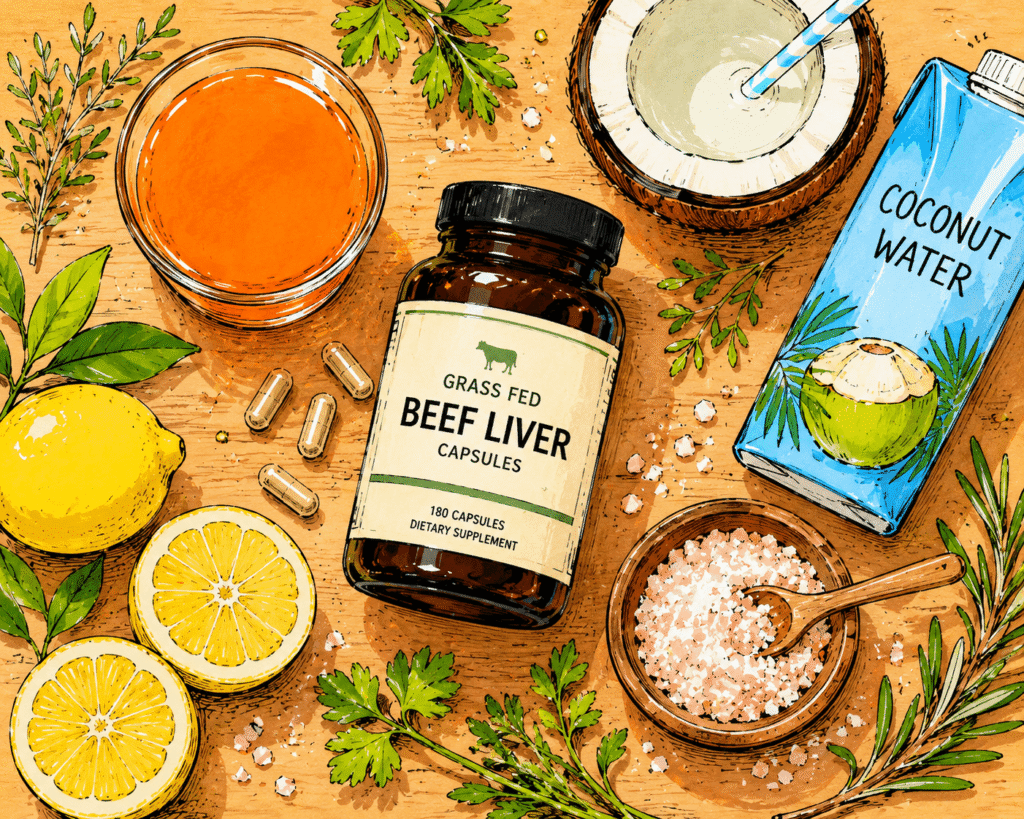
Liver provides heme iron, which is the most bioavailable form of iron that exists. But more importantly it provides the cofactors the body needs to actually use that iron. Bioavailable copper in the form of ceruloplasmin-supportive retinol. Zinc in proper ratio to copper. B vitamins in concentrations you simply cannot replicate with isolated supplements.
For people who cannot stomach eating liver directly, grass fed desiccated beef liver supplements provide the same nutritional matrix in capsule form.
This is what I personally use and what I recommend to anyone asking me how to move iron in the body through food first.
The B Vitamins in Liver and Why They Matter for Red Blood Cells
Grass fed liver is one of the most concentrated sources of B vitamins available from any food. And those B vitamins are doing specific and essential work in the red blood cell pathway.
B12 and folate are both directly required for red blood cell maturation. Without adequate B12 and folate, the body produces red blood cells that are too large and too fragile to function properly. This is megaloblastic anemia and it has nothing to do with iron but everything to do with what is sitting in your liver capsule.
B6 is required for heme synthesis, which is the iron-containing portion of hemoglobin. Without B6, the body cannot assemble heme properly even when iron is present. B2 (riboflavin) supports the conversion of B6 into its active form and also plays a direct role in iron mobilization from storage sites.
What this means practically is that grass fed liver is not just an iron food. It is a complete red blood cell support food. Every cofactor needed to build, mature, and load a healthy red blood cell with functional iron is present in the right ratios. This is ancestral nutrition working exactly as designed.
What Does Fermented Cod Liver Oil Have To Do With Iron?
Fermented cod liver oil provides fat-soluble vitamins A and D in their natural whole food ratios.
Cod liver oil makes copper more bioavailable, and it helps move iron. This is why you will see perimenopausal or menopausal women start taking it and get relief from hot flashes.
But I digress… the whole-food ratios matter for iron movement because retinol (true vitamin A, not beta-carotene) is required for ceruloplasmin production.
It is also required for mobilizing iron from liver storage, which is one of the key steps in understanding how to move iron in the body when it has become sequestered.
Vitamin D supports immune regulation and reduces the chronic inflammatory signaling that contributes to iron sequestration in the first place.
The combination of fermented cod liver oil with grass fed liver is one of the most ancestrally validated nutritional stacks for mineral balance and red blood cell health.
These two foods together have been part of traditional diets in cold climate cultures for centuries, and the biochemistry explains why.
Why Whole Food Vitamin C Is Essential Here
This is where a lot of people make a mistake that actually worsens iron dysregulation.
Synthetic ascorbic acid, which is what most vitamin C supplements contain, reduces ferric iron to ferrous iron and drives iron absorption.
In someone who already has iron accumulation or stuck iron in tissue, that is the last thing you want.
Whole food vitamin C works differently.
The full vitamin C complex includes copper-dependent enzymes like tyrosinase and laccase that actually support ceruloplasmin synthesis.
This is the mechanism that makes whole food vitamin C a tool for iron movement rather than iron loading.
The best whole food vitamin C sources I have found are acerola cherry and gubinge, also known as Kakadu plum, which is one of the highest known natural vitamin C concentrations of any food on the planet.
This is what I use in my adrenal cocktail recipe below and what I recommend to anyone working on how to move iron in the body through a nutritional protocol.
What Is an Adrenal Cocktail and How Does It Support Iron?
The adrenal glands produce ceruloplasmin.
This is the connection most people miss entirely. When the adrenals are depleted, which is nearly universal in anyone with chronic illness or chronic stress, ceruloplasmin production drops and iron movement stalls.
An adrenal cocktail provides the three things exhausted adrenals need most: whole food vitamin C, sodium, and potassium.
These nutrients directly support adrenal function and, by extension, ceruloplasmin production and iron mobility.
My version uses gubinge and acerola for whole food vitamin C rather than orange juice, which spikes blood sugar and provides synthetic-adjacent ascorbic acid rather than the full complex.
Coconut water provides potassium. Celtic sea salt or Baja Gold provides sodium and trace minerals.
The result is an adrenal cocktail that is genuinely doing the work at the ceruloplasmin level, not just replenishing electrolytes on the surface.

Dodee's Adrenal Cocktail
Whole Food Vitamin C — No Orange Juice
Lazy day? No judgment. Grab a high quality ready-made adrenal cocktail right here.
Shop Ready-Made Adrenal CocktailWhat Is Blood Letting and How Does It Support Iron Movement?
Blood letting sounds extreme in a modern context. But therapeutic phlebotomy and regular blood donation are among the most direct and time-honored ways to reduce iron burden in someone who is accumulating excess iron in tissue.
When you donate blood or undergo therapeutic phlebotomy, you remove iron from the body in its most concentrated form, inside red blood cells. The body then has to produce new red blood cells, which pulls stored iron out of tissue and back into circulation where it can be cleared. This is a deeply ancestral practice. Traditional cultures around the world used bloodletting as a regular maintenance protocol, not just as an emergency intervention.
Integrative practitioners who work with iron dysregulation often observe that regular blood donation, as frequently as every eight weeks for those who qualify, produces measurable shifts in ferritin and iron saturation over time. It is worth discussing with a practitioner who understands iron movement, particularly if your ferritin is elevated or you have known hemochromatosis.
Menstruation is also worth acknowledging here as a natural iron regulation mechanism. The monthly blood loss that menstruating women experience is one of the reasons pre-menopausal women tend to have lower rates of iron accumulation than men of the same age. When menstruation stops, whether through menopause or other causes, iron regulation requires more intentional attention.
Ready To Go Deeper on Iron, Minerals, and Hormonal Health?
Join a thriving community of women learning how to restore mineral balance, move iron properly, and reclaim their energy — all in one place.
- Deep dives into ceruloplasmin, copper, and iron dysregulation
- Practitioner-guided protocols for real results
- A supportive community of women on the same path
- Resources on adrenal health, hormones, and ancestral nutrition
Affiliate link — I may earn a commission at no extra cost to you.
What Else Supports Iron Movement?
Beyond the core protocol, a few other tools are worth knowing about.
Lactoferrin is a protein found in colostrum and raw dairy that binds iron in the gut and prevents pathogenic bacteria from accessing it. It also helps regulate how much iron gets absorbed in the first place. For anyone with a gut infection picture alongside iron dysregulation, lactoferrin is a tool worth exploring with a practitioner.
Apolactoferrin can be used in cases of iron overload.
IP6 (inositol hexaphosphate) is a natural compound found in whole grains and legumes that has shown in research to chelate excess iron and support its removal from storage sites. Rice bran is a great one to consider.
Some integrative practitioners use it specifically for iron overload situations.
Coffee, particularly black organic coffee consumed away from meals, acts as a natural iron chelator.
This is one reason moderate coffee consumption has been associated with lower ferritin in observational research.
It is not a protocol in itself but it is a useful piece of context if you drink it regularly.
Castor oil packs over the liver support lymphatic drainage and liver detoxification, which indirectly support the liver’s ability to produce ceruloplasmin and process iron properly.
Avoiding cast iron cookware during periods of high iron load is also worth considering. Cooking acidic foods in cast iron can significantly increase dietary iron intake in ways that are not always obvious.
The Bigger Picture
Learning how to move iron in the body is really learning how to restore mineral balance from the inside out. Iron does not operate alone. It moves because copper is present. Copper is bioavailable because the liver is supported. The liver is supported because the adrenals are nourished. The adrenals are nourished because whole food vitamin C and trace minerals are coming in daily through real food and thoughtful supplementation.
This is the ancestral protocol. Grass fed liver, fermented cod liver oil, whole food vitamin C, adrenal support, and where needed, therapeutic blood removal to clear what has accumulated. These are not new ideas. They are old ideas that we stopped practicing and are now remembering.
If you are still trying to figure out how to move iron in the body and conventional approaches have not given you the answers you are looking for, start with the terrain. Restore the cofactors. Trust the wisdom that whole food nutrition has always carried.
Did You Get It? Test Your Knowledge
Two quick questions from the article
1. What protein does your body need to move iron out of storage and into your red blood cells?
2. Which of the following is the best whole food source of bioavailable copper, B vitamins, and heme iron all in one?
DisclaimerThis article is for informational purposes only and does not constitute medical advice. Always consult with a qualified healthcare practitioner before beginning any new protocol. Statements in this article have not been evaluated by the FDA and are not intended to replace or substitute for professional medical care.

POPULAR POSTS


MEDITATIONS