
If you have spent any time in integrative health circles over the last several years, you have probably heard the name fenbendazole come up in conversations about cancer.
What started as a veterinary antiparasitic has quietly become one of the most talked-about compounds in the world of complementary oncology support, and the research behind why is genuinely worth understanding.
I want to be clear from the start: I am not making any medical claims here. What I am doing is sharing what the research suggests, what integrative practitioners have observed, and why I think the fenbendazole and cancer conversation deserves more than dismissal.
What Is Fenbendazole?
Fenbendazole is a benzimidazole compound that has been used in veterinary medicine for decades to address parasitic infections in animals. It works by interfering with the way parasites form and maintain their cellular structure, effectively disrupting their ability to survive and replicate.
It is inexpensive, widely available, and has a long safety record in animal medicine. What brought it into the human wellness conversation was a combination of compelling anecdotal reports and a growing body of laboratory research suggesting it may have mechanisms relevant to cellular health that go well beyond its original intended use.
The Joe Tippens Story
In 2016, Joe Tippens was given three months to live after a small cell lung cancer diagnosis that had spread throughout his body. By 2017 he was cancer free. He attributed his turnaround to a protocol that included fenbendazole, vitamin E succinate, bioavailable curcumin, and CBD oil.
His story went viral in South Korea, where it triggered a wave of research interest and a significant uptick in people using fenbendazole as a complementary support alongside conventional oncology care. Whether his outcome was due entirely to the protocol, partially to it, or to other factors, his story opened a door that has not closed since.
How Does Fenbendazole Work in the Body?
This is where the science gets interesting. Research suggests fenbendazole may work through several mechanisms that overlap with how certain pharmaceutical oncology agents function.
The first is microtubule disruption. Cancer cells rely on structures called microtubules to divide and replicate. Fenbendazole appears to interfere with tubulin polymerization, the process that forms these structures, which may inhibit cancer cell division. This is the same general target as taxane chemotherapy drugs like paclitaxel.
The second involves glucose metabolism. Cancer cells are heavily dependent on glucose for energy. This is known as the Warburg effect. Research suggests fenbendazole may impair GLUT transporters and hexokinase activity, both of which cancer cells rely on to access glucose. In simple terms, it may interfere with the cancer cell’s ability to feed itself.
Third, fenbendazole has shown pro-apoptotic effects in laboratory studies, meaning it may support the process of programmed cell death in abnormal cells while leaving healthy cells relatively unaffected.
Fourth, some research points to possible anti-angiogenic properties, suggesting it may interfere with a tumor’s ability to generate the new blood vessels it needs to grow and spread.
I want to be transparent that most of this research is in vitro or animal-based. Human clinical trial data is still limited. This is an emerging area and one worth watching closely, not one with settled conclusions.
What Types of Parasitic Infections Does Fenbendazole Address?
In its traditional veterinary role, fenbendazole is a broad spectrum antiparasitic. It has been used to address roundworms, hookworms, whipworms, pinworms, Giardia, certain tapeworm species, and lungworms.
For those of us coming at health through a chronic illness or Lyme lens, the Giardia connection is particularly relevant. Giardia is a protozoan parasite that causes significant gastrointestinal disruption, malabsorption, and immune dysregulation. It shows up frequently in people with compromised gut terrain and is often a missing piece in chronic symptom pictures that do not fully resolve with standard approaches.
The Parasite and Cancer Connection: Why Terrain Matters
Integrative practitioners have long understood that chronic parasitic burden creates a terrain problem. Parasites compete with the host for nutrients, produce toxic metabolic byproducts, contribute to biofilm formation, and create a state of chronic immune activation that over time can exhaust the immune system’s ability to identify and clear abnormal cells.
The terrain theory of disease, which has deep roots in European biological medicine, holds that the internal environment of the body matters as much as or more than any single pathogen or abnormal cell. When the terrain is burdened, everything downstream is compromised.
This is why the conversation about fenbendazole and cancer is not just about the compound itself. It is about addressing the full picture of what may be creating a permissive environment for disease in the first place.
Why I Believe Supporting the Liver Is Non-Negotiable Here
Fenbendazole is processed hepatically. That means it runs through the liver.
When you combine that with the die-off reactions that can accompany any antiparasitic protocol…the release of endotoxins, parasite waste, and cellular debris… You are asking a lot of the liver all at once.
This is exactly why Dr Group developed a liver cleanse protocol specifically designed to be used alongside fenbendazole.
The adjustments I personally made are to substitute TUDCA for Epsom salt.
I also like a daytime liver flush so I can be present during the liver cleanse. It is up to you.
The olive oil base in this protocol is not incidental.
Fenbendazole requires a healthy fat to absorb properly, and combining it with cold-pressed organic olive oil makes it significantly more bioavailable.
This is one of those cases where the protocol design and the therapeutic support genuinely reinforce each other.
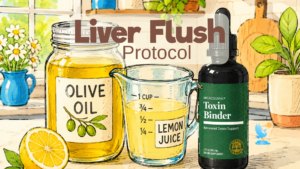
Cancer Liver Cleanse Protocol
Repeat every third day — most people need 9 to 18 rounds for a thorough liver cleanse. My personal preference is daytime but you can always switch to an evening protocol.
- 3 ounces cold-pressed organic olive oil
- Juice of 1 fresh organic lemon or grapefruit
- 1 teaspoon organic black seed oil
- ½ bottle Global Healing Liver Health formula
- ½ inch Dur-Vet Ivermectin Paste
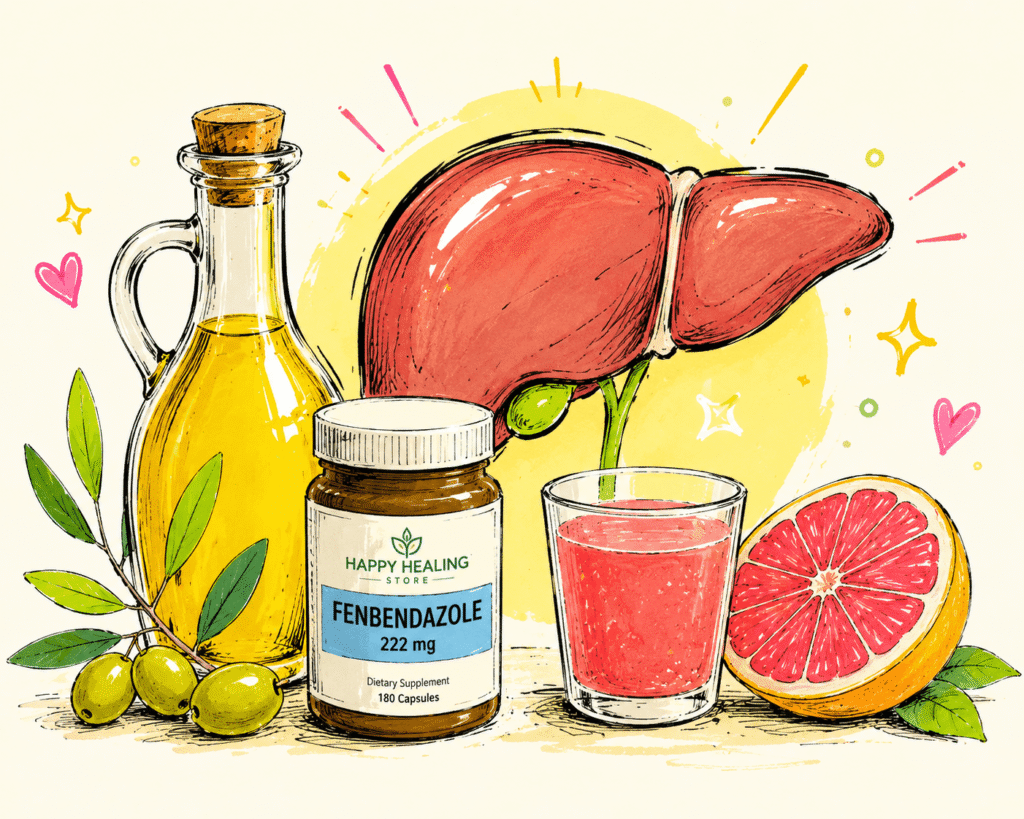
- Fenbendazole pure powder from the Happy Healing Store — 1 scoopFenbendazole requires a healthy fat to absorb properly. The olive oil base makes it highly bioavailable — this pairing is intentional and powerful.
- 9 drops DMSO
- 6 capsules Supercharged C60 emptied into the mix
- 1 teaspoon organic raw apple cider vinegar
The Tippens Protocol — What He Actually Used
For reference, the protocol Joe Tippens documented publicly included fenbendazole at 222mg three days on and four days off, vitamin E succinate, bioavailable curcumin, and CBD oil.
This is the most-cited framework in the integrative fenbendazole conversation and the starting point that most practitioners reference.
I source my fenbendazole as a pure powder from the Happy Healing Store, which allows for precise dosing and easy incorporation into protocols like the liver cleanse above.
Everything here is off-label human use.
This is not a pharmaceutical protocol.
Work with a knowledgeable practitioner who can monitor your liver enzymes and adjust accordingly.
What to Consider Before You Start
A few things worth knowing before you move forward with any fenbendazole protocol.
Die-off reactions are real. When you begin clearing parasites, you may experience fatigue, brain fog, skin eruptions, or digestive changes as the body processes what is being released.
This is sometimes called a Herxheimer-type reaction and is a sign the protocol is working, not a reason to stop.
The liver cleanse protocol above is specifically designed to support your body through this process.
Liver enzyme monitoring is worth doing.
Because fenbendazole is hepatically processed, having baseline liver enzymes and rechecking at intervals is a reasonable precaution, especially if you are using it for an extended period.
It is not a replacement for conventional care.
Fenbendazole and cancer research is compelling but it is not a substitute for working with qualified practitioners.
The most thoughtful integrative approaches use it as a complementary layer, not a standalone intervention.
A Note on Sourcing
Purity matters enormously with fenbendazole. I use and recommend the pure powder from the Happy Healing Store specifically because of the quality and because the powder form allows you to incorporate it into fat-based protocols like the liver cleanse above, maximizing absorption.
For the DMSO, olive oil, and other components in the protocol, my affiliate links above connect you directly to the specific products I use personally.
The Bigger Picture
The conversation around fenbendazole and cancer is really a conversation about terrain, about parasitic burden as an underaddressed driver of immune dysfunction, and about how sometimes the tools that have been hiding in plain sight turn out to be among the most interesting ones worth exploring.
I have been in this space long enough to know that the most powerful shifts rarely come from a single compound. They come from addressing the full picture… the gut, the liver, the lymph, the emotional body, the terrain at every level. Fenbendazole is one piece of a much larger protocol. But it is a piece that I think deserves your attention.
As always, do your own research, work with a practitioner who understands this space, and trust your body’s innate intelligence to guide the process.
DisclaimerThis article is for informational purposes only and does not constitute medical advice. Always consult with a qualified healthcare practitioner before beginning any new protocol. Statements in this article have not been evaluated by the FDA and are not intended to diagnose, treat, cure, or prevent any disease.