When I connect with someone who has just been handed a Hashimoto’s diagnosis, the first question is almost always the same.
What do I eat now?
I understand that question in my bones.
Food is one of the few levers we get to hold ourselves, and building a
Hashimoto’s diet plan that actually supports your body is one of the most grounding things you can do while you figure out the rest.
I want to walk you through a simple, seven-day rhythm I return to again and again in my own practice and in my own life.
This is not a rigid prescription. It is a starting rhythm you can shape around your own body, your own triggers, and your own season of healing.

Black seed oil is one of my go-to picks for thyroid support; studies show it may help calm antibody levels and ease the inflammation that comes with Hashimoto’s
Why Does Food Matter So Much With Hashimoto’s?
Hashimoto’s is an autoimmune pattern, which means the immune system is already working overtime.
Every meal is either adding fuel to that fire or helping to calm it down.
I think of the gut and the thyroid as two ends of the same conversation.
When the gut lining is inflamed or irritated, the immune system stays on high alert, and that alert state tends to keep antibody levels elevated.
This is why a Hashimoto’s diet plan is never really just about the thyroid gland itself.
It is about lowering the overall inflammatory load your body is carrying so your nervous system, your gut, and your immune system can finally exhale.
What Foods Tend to Trigger Hashimoto’s Flares?
I always tell people that triggers are personal, and a thirty day elimination period followed by careful reintroduction is the most honest way to find your own list.
That said, a few foods show up again and again in the research and in my own client work.
The Big Three to Watch
Gluten. This is the one I hear about most often.
Gluten can prompt an immune reaction that cross-reacts with thyroid tissue, and many people notice antibody improvement within a few months of removing it.
I will say it could truly just be the glyphosate pesticide causing so many issues with some patients.
People report going to countries without glyphosate in their foods and being able to eat breads they could not eat here in the USA without severe reactions.
So it is something to consider.
Dairy. Cow’s milk proteins are inflammatory for a meaningful number of people with Hashimoto’s, even without a diagnosed allergy.
Some patients can handle A2 dairy just fine. Again, I would know your farmer and see if it works for you personally or not.
It can be good to at least do 30 days without dairy and then reintroduce it slowly to be sure it is not an issue for you.
Soy. Beyond the phytoestrogen conversation, soy can interfere with iodine uptake, which matters most if your iodine intake is already on the higher side.
What You May Not Know About Conventional Dairy
There is another layer to the dairy conversation worth naming honestly.
Bovine leukemia virus, a virus that naturally infects cattle, is remarkably widespread in the United States dairy herd.
A 2018 study published in PLOS ONE tested cows across 103 commercial US dairy herds and found that 94.2 percent of herds had at least one BLV antibody positive cow, with an average within herd prevalence of 46.5 percent (LaDronka et al., 2018).
I want to be precise here rather than alarmist. This research is specific to cattle.
I was not able to find comparable natural prevalence data for commercial goat dairy, so I am not going to extend that same figure to goat milk products.
What I have learned from a trusted source is that sheep dairy is clean, and the more you can get sheep dairy, the better off you are if you enjoy dairy.
Otherwise, know your farmer and source, and that’s all I am saying.
Current published research also has not established a confirmed link between BLV and human disease through milk consumption, so I share this as a transparency point about the conventional dairy supply rather than a proven human health claim.
Alcohol.
This one is worth taking seriously.
Alcohol is directly toxic to thyroid cells and suppresses both TSH and TRH, and it also places an extra burden on the liver, which is where the majority of T4 gets converted into the active T3 hormone your cells actually use.
Protecting that conversion pathway is a big part of why I treat alcohol as a real trigger, not just an afterthought.
Coffee. I used to treat this as purely a medication timing issue, and timing does matter, but I want to be fair to the fuller picture.
Coffee and other caffeinated teas can also be a direct irritant for some people with Hashimoto’s, independent of when you take your medication.
If you notice a flare pattern, it is worth testing a real break from coffee rather than only shifting the clock on it.
That said, sometimes it is just the mold and glyphosate sprayed on the coffee. You may do well with a clean coffee that tests for these things.
Industrial seed oils. Highly processed oils like soybean, corn, canola, and cottonseed oil carry a heavy omega-6 load that tends to push the body toward a more inflammatory state.
I have a full breakdown of why these oils deserve real scrutiny in my seed oil article, which I will link here.
Excess iodine deserves its own mention here.
Large doses, often from kelp or seaweed supplements, can worsen thyroid autoimmunity in people who are already genetically prone to it. This is one place where more is not better.
Raw cruciferous vegetables in very large quantities, think a daily pound of raw kale in a smoothie, can also be goitrogenic.
Cooking deactivates most of that effect, so a normal serving of roasted broccoli is a very different story than a daily raw green juice habit.
A quick note before we go further.
This rhythm reflects a general, anti-inflammatory approach to Hashimoto’s, not the stricter Autoimmune Protocol.
If you are following AIP, legumes, seeds, nuts, and eggs are excluded there, and I will be covering that version in its own dedicated piece soon.
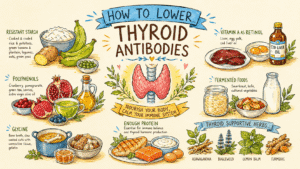
What Foods Traditionally Support Thyroid Health?
Once the biggest triggers are off the plate, I like to fill that space intentionally rather than leaving it empty.
A few categories I lean on again and again.
Fiber from berries, pears, citrus, lentils, chickpeas, and well-cooked non-starchy vegetables.
Fiber supports the gut lining directly, and a calmer gut tends to mean a calmer immune system.
Selenium-rich foods like Brazil nuts, sardines, and pasture-raised eggs.
The thyroid holds the highest concentration of selenium of any organ in the body, so this mineral is foundational rather than optional.
Zinc rich foods like pumpkin seeds, grass fed beef, and oysters, which support the conversion of T4 into the active T3 hormone your cells actually use.
Omega-3 sources like wild salmon and sardines, which help lower the overall inflammatory tone of the body.
Protein deserves its own spotlight, and I do not say that lightly.
Quality protein is a building block for thyroid hormone conversion and for maintaining lean muscle, which tends to be one of the first things to slip when thyroid function is struggling.
Bone broth protein is one of my favorite ways to bring this in gently, since it is easy to digest and pairs naturally with the gut support this whole rhythm is built around.
I also keep an eye on a few botanicals that show up consistently in integrative practitioner circles, including black seed oil and aloe vera juice, both of which practitioners observe may support antibody balance over time.
I always recommend working with your own practitioner before adding anything new.
Hashimoto’s Diet Plan
A Simple Seven Day Nourishment Rhythm
I want to offer this as a rhythm rather than a rulebook. Repeat it, adjust it, and let your own body tell you what needs to change.
Day One. Anchor the day with protein and healthy fat at breakfast, and remove one obvious trigger food completely.
Day Two. Add one selenium rich food and one zinc rich food somewhere in the day.
Day Three. Focus on fiber. Add a legume based lunch or dinner.
Day Four. Cook your cruciferous vegetables rather than eating them raw, and notice how you feel.
Day Five. Add an omega three rich meal, like wild salmon with roasted vegetables.
Day Six. Batch cook something warm and simple for the week ahead, since steady blood sugar matters as much as any single ingredient.
Day Seven. Rest, reflect, and notice what shifted. Energy, digestion, mood, and sleep are all worth tracking here.
Hashimoto's food guide
A gentle map of what to enjoy, limit, and watch for
Berries, pears, citrus
Gentle on the gut and rich in fiber and antioxidants.
Wild salmon, sardines
Omega threes to help calm overall inflammation.
Pasture raised eggs
A complete, easy to digest protein with natural selenium and zinc.
Grass fed beef
Rich in zinc and iron, both important for thyroid hormone production.
Turkey and chicken
Lighter proteins that are gentle on digestion while still supporting your daily protein target.
Wild caught white fish
Cod, halibut, and similar options for variety beyond salmon and sardines.
Lentils and chickpeas
Fiber and plant protein that support steady digestion. A small number of people find lectins worsen symptoms, so this is a good one to test for yourself.
Pumpkin seeds
A gentle source of zinc for hormone conversion.
Bone broth protein
An easy to digest way to hit a real protein target, since protein is a building block for thyroid hormone conversion and lean muscle.
Cooked root vegetables
Warm, easy to digest, and steadying for blood sugar.
Raw cruciferous vegetables
Broccoli, kale, and cabbage are lovely once cooked. Raw and in large daily amounts is where I'd slow down.
Kelp and seaweed supplements
A little goes a long way here. Large iodine doses are the one place more is not better.
Coffee near medication
Best enjoyed at least thirty to sixty minutes away from a morning thyroid dose.
High fiber meals near medication
Wonderful for the gut, just worth spacing a few hours from thyroid medication.
Nightshades
Tomatoes, potatoes, peppers, and eggplant are fine for many, but worth testing if you notice a flare pattern.
High-glycemic fruit
Watermelon, mango, and grapes are lovely in moderation, just watch portion size if blood sugar swings are a trigger for you.
Gluten
The most commonly reported trigger among the Hashimoto's community.
Conventional dairy
Cow's milk proteins are inflammatory for many, even without a diagnosed allergy.
Conventional dairy
Cow's milk proteins are inflammatory for many, even without a diagnosed allergy. Worth knowing too: research shows bovine leukemia virus is present in the large majority of US dairy herds, which is a transparency point about the supply, not a proven human health claim.
Alcohol
Toxic to thyroid cells and taxes the liver, where most T4 converts to active T3.
Coffee
Beyond medication timing, it can be a direct irritant for some. Worth a real trial break if you notice a flare pattern.
Industrial seed oils
Soybean, corn, canola, and cottonseed oil carry a heavy omega six load. See my seed oil article for the full picture.
Soy
Can interfere with iodine uptake and thyroid hormone production.
Highly processed foods
Add to overall inflammatory load without offering much nourishment in return.
Multi-strain probiotic
Lactobacillus, Bifidobacterium, and a soil-based organism together, rather than one strain alone. Keep four hours from thyroid medication.
Selenium
Brazil nuts, sardines, and pasture raised eggs. The thyroid holds more selenium than any other organ.
Zinc
Pumpkin seeds, grass fed beef, and oysters support T4 to T3 conversion.
Vitamin D3 with K2
Deficiency is common in autoimmune thyroid patterns and worth checking with your practitioner.
Black seed oil
Practitioners observe this may support antibody balance over time.
Aloe vera juice
Traditionally used alongside gut and antibody support.
Myo-inositol
Often paired with selenium in integrative protocols.
Is Your Liver Blocking Your Thyroid Progress?
Here’s something I want you to really sit with: your liver does the majority of the work converting T4 into the active T3 your cells actually use.
If your liver is sluggish or overburdened, you can be doing everything else right, clean diet, the right supplements, and still feel stuck, because the conversion pathway itself is bottlenecked.
This is why I consider liver support foundational to any Hashimoto’s approach, not optional and not an afterthought.
Cultures far apart from each other have understood this for centuries.
Cardo Mariano grows at the edge of Sardinian olive groves.
Amish households keep milk thistle by the kitchen door.
Traditional Chinese Medicine named the liver as central to metabolic regulation long before Western science had language for the conversion pathway, and Ayurvedic practitioners have prescribed liver-supporting herbs for thousands of years.
The active compound in milk thistle, silymarin, is one of the most studied liver-support compounds available.
Early animal research suggests it may support T4 to T3 conversion in liver tissue.
I want to be fully honest with you though, newer research has also identified a specific silymarin compound that can interfere with how thyroid hormone moves into cells, with real caution raised specifically around pregnancy.
This is a place where I’d lean on your own practitioner before adding milk thistle to your routine.
If your liver is under a real burden, minerals and targeted supplements have a much harder time doing their job.
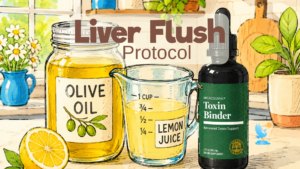
That’s the whole premise behind my liver flush protocol, and I’d encourage you to start there if you suspect your liver needs support before anything else.
A Note on Medication Timing
f you take thyroid medication, keep high fiber meals and calcium or iron rich foods a few hours away from your dose. This single timing adjustment can matter more for absorption than almost any food choice on its own.
Working This Rhythm Into Your Own Life
A Hashimoto’s diet plan is never about perfection.
It is about steadily lowering your body’s inflammatory load while keeping your nervous system calm enough to actually heal.
I encourage you to hold this rhythm loosely, let your own body guide the pace, and bring in your practitioner for anything that touches medication, lab work, or supplementation.
I hope it gives you a steady place to begin your own Hashimoto’s diet plan. Using a journal to know which foods cause triggers is a huge help!
This article is educational and reflects integrative and traditional wellness perspectives. It is not a substitute for medical care. Please consult your physician or a qualified practitioner before changing your diet, medication timing, or supplement routine.
References
Peng B, Wang W, Gu Q, et al. Effects of different supplements on Hashimoto’s thyroiditis: a systematic review and network meta-analysis. Frontiers in Endocrinology. 2024;15.
Winther KH, et al. Selenium in autoimmune thyroiditis (CATALYST trial). 2020.
Tajmiri S, Farhangi MA, Dehghan P. Nigella Sativa treatment and thyroid hormone concentrations in Hashimoto’s Thyroiditis patients. European Journal of Integrative Medicine. 2016;8(4):576-580.
Kubiak K, Szmidt MK, Kaluza J, et al. Do dietary supplements affect inflammation and oxidative stress in Hashimoto’s disease? A systematic review. Antioxidants. 2023;12(10):1798.
VITAL Trial. Vitamin D3 supplementation and autoimmune disease incidence. New England Journal of Medicine. 2022.
LaDronka RM, Ainsworth S, Wilkins MJ, Norby B, Byrem TM, Bartlett PC. Prevalence of Bovine Leukemia Virus Antibodies in US Dairy Cattle. Veterinary Medicine International. 2018.
Erskine RJ, et al. Bovine leukemia virus prevalence and impact on US dairy herds, cited via LaDronka et al., 2018 herd level dataset.